


Autorefractor Eye Test: How This Advanced Eye Checkup Machine Helps Evaluate Your Vision
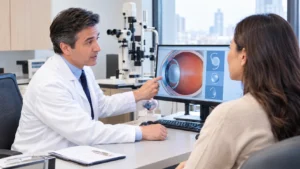
Clear vision depends on how accurately your eyes focus light. During a comprehensive eye examination, ophthalmologists use advanced diagnostic technology to understand how your eyes function and identify whether you need glasses, contact lenses, or additional vision care.
One of the commonly used technologies in modern eye exams is an autorefractor eye test. This quick and painless procedure helps measure how your eyes focus light and provides important information about your possible vision prescription.
At LeeVision in Flushing, Queens, NYC, Dr. David H. Lee, MD, a Board-Certified Ophthalmologist, uses advanced eye diagnostic technology along with a detailed clinical evaluation to understand each patient’s unique vision needs. An autorefractor is an important tool, but it works as part of a complete eye examination rather than replacing the expertise of an ophthalmologist.
What Is an Autorefractor Eye Test?
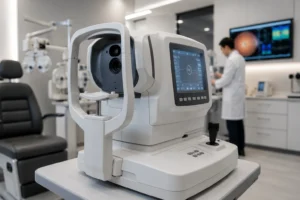
An autorefractor eye test is an automated measurement used during an eye examination to evaluate how light enters and focuses inside the eye.
The test is performed using a device called an auto refractometer. The machine sends a small amount of light into the eye and analyzes how that light reflects back from the retina.
This measurement helps estimate whether a person may have common vision problems such as:
- Myopia (nearsightedness): Difficulty seeing objects clearly at a distance
- Hyperopia (farsightedness): Difficulty focusing on nearby objects
- Astigmatism: Blurred or distorted vision caused by an irregularly shaped cornea
The results give the ophthalmologist a starting point for determining a patient’s vision correction needs.
However, an autorefractor does not independently diagnose every eye condition or create a final prescription. A qualified eye doctor combines these measurements with other tests, patient symptoms, and overall eye health findings.
How Does an Auto Refractometer Work?
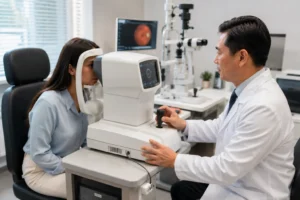
An auto refractometer uses advanced optical technology to measure the way your eyes focus light.
During the test, the machine evaluates how light travels through different structures of the eye, including the cornea and lens. The device then calculates an estimate of the refractive error.
Measuring Refractive Error
When the eye cannot focus light properly on the retina, vision may become blurry. The autorefractor helps identify the type and approximate level of correction that may be needed.
For example:
- A patient with myopia may require lenses that help focus distant images clearly.
- Someone with astigmatism may need lenses designed to correct uneven focusing.
- Older adults may experience changes related to presbyopia that require additional evaluation.
The information collected by the machine allows the ophthalmologist to perform a more accurate and personalized vision assessment.
What Happens During an Autorefractor Eye Test?
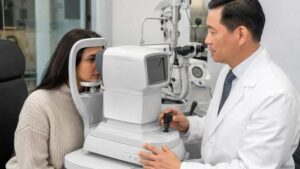
Many patients are curious about what to expect during this part of an eye exam. The process is simple and usually takes only a few seconds.
Step 1: Eye Positioning
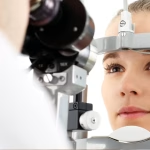
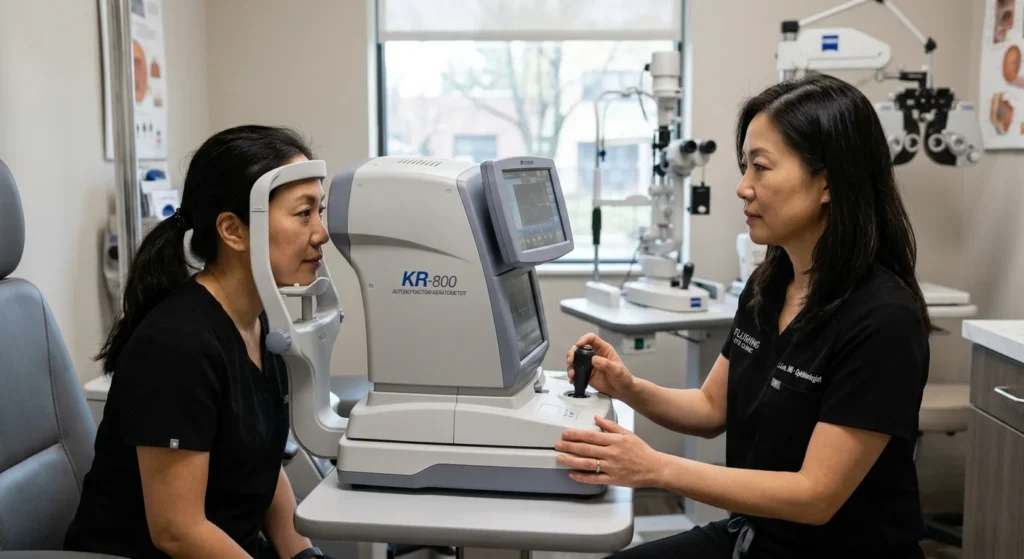
The patient sits comfortably and places their chin and forehead on the machine support. This helps keep the eyes properly aligned.
Step 2: Looking at the Target Image
The patient looks at a small image inside the device. The goal is to keep the eyes relaxed and focused naturally.
Step 3: Automatic Measurement
The autorefractor captures measurements from each eye. The process is completely non-invasive and does not touch the eye.
Step 4: Ophthalmologist Review
After the measurement, the ophthalmologist reviews the results along with other examination findings to understand the patient’s complete visual condition.
For patients in Flushing, Queens, and surrounding New York City communities, these technologies help make eye evaluations more efficient while supporting personalized treatment planning.
Is an Autorefractor the Same as a Complete Eye Exam?
A common question patients ask is whether an autorefractor can replace a full eye examination.
The answer is no.
An eye checkup machine such as an autorefractor provides valuable information about vision focusing ability, but a complete eye exam evaluates much more, including:
- Eye pressure
- Corneal health
- Retina condition
- Signs of eye diseases
- Changes in vision over time
This is especially important because some eye conditions may develop without noticeable symptoms in the early stages.
Regular professional eye examinations allow ophthalmologists to monitor long-term vision health and identify potential concerns before they become more serious.
What Does an Autorefractor Image Show During an Eye Test?
Many patients search for an autorefractor image because they want to understand what they will see during the examination. The image displayed inside an autorefractor is usually a simple target, such as a landscape, balloon, or other visual object, designed to help the eyes remain relaxed while the machine takes measurements.
The purpose of this image is not to test eyesight like reading an eye chart. Instead, it helps the autorefractor maintain proper focus while analyzing how light travels through the eye.
Patients often assume they need to concentrate hard during this test, but the opposite is usually recommended. Relaxed eyes provide more reliable measurements because the machine is evaluating the eye’s natural focusing behavior.
Modern autorefractors are designed to make the experience comfortable, especially for patients who may feel nervous about eye testing. The process is quick, painless, and suitable for many age groups.
Benefits of Using an Autorefractor During an Eye Examination
An auto refractometer has become an important part of many modern ophthalmology practices because it allows doctors to collect detailed information efficiently.
Some important benefits include:
Faster Initial Vision Assessment
Traditional vision testing requires patients to respond to different lens choices manually. An autorefractor provides an initial measurement within seconds, helping the eye care team understand where to begin.
More Objective Measurements
Because the machine automatically analyzes how light behaves inside the eye, it can provide an objective estimate of refractive error.
This can be particularly helpful for:
- Children who may have difficulty explaining vision problems
- Older adults with changing eyesight
- Patients undergoing comprehensive eye evaluations
Helps Create Personalized Vision Plans
The autorefractor measurement is combined with other examination findings to create a personalized approach.
At LeeVision, technology is used alongside professional medical judgment. Dr. David H. Lee, MD evaluates each patient individually because vision correction is not only about numbers on a prescription — it is about understanding how a person uses their vision in daily life.
For example, a computer professional may have different visual needs compared with someone who drives frequently, reads extensively, or participates in outdoor activities.
Limitations of an Autorefractor Eye Test
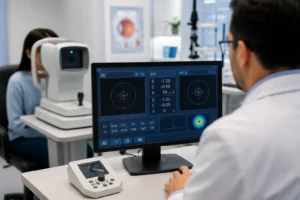
Although an autorefractor eye test is valuable, patients should understand that it is only one component of a complete eye evaluation.
The machine cannot fully evaluate every aspect of eye health.
An autorefractor does not replace:
- A detailed medical eye history
- Evaluation of eye diseases
- Assessment of eye coordination and focusing ability
- Doctor interpretation of symptoms
For example, two people may have similar autorefractor measurements but completely different eye health situations. One person may simply need updated glasses, while another may require additional testing for an underlying condition.
This is why examination by a Board-Certified Ophthalmologist remains essential.
Autorefractor vs Traditional Eye Exam: What Is the Difference?
Patients often ask whether an autorefractor is better than a traditional eye test. In reality, both methods serve different purposes.
| Autorefractor Eye Test | Traditional Vision Testing |
|---|---|
| Provides an automatic measurement | Requires patient responses |
| Quick and objective | Allows subjective vision refinement |
| Gives an estimated prescription range | Helps determine final prescription accuracy |
| Used as part of the initial evaluation | Used for detailed vision correction decisions |
During a professional eye examination, ophthalmologists often use both technology and patient feedback to achieve the most accurate understanding of vision needs.
Who May Benefit From an Autorefractor Eye Test?
An autorefractor may be useful for many patients during routine eye care, including:
Adults With Changing Vision
Vision naturally changes throughout life. Adults may notice difficulty reading, driving at night, or focusing on digital screens.
Children and Teenagers
Children may not always recognize or communicate that their vision is unclear. Early detection of refractive problems can support healthy visual development.
Contact Lens Wearers
Patients who wear contact lenses may need regular vision assessments to ensure their prescription remains appropriate.
Patients Considering Vision Correction Procedures
People exploring procedures such as LASIK or other refractive treatments usually require detailed measurements of the eye before determining candidacy.
Why Advanced Eye Testing Matters in Flushing, Queens, NYC
Life in New York City can place unique demands on vision. Many patients in Flushing and surrounding Queens communities spend long hours using smartphones, computers, and digital devices.
Common concerns include:
- Digital eye strain
- Difficulty focusing after prolonged screen use
- Dry, irritated eyes
- Changes in near and distance vision
In addition, seasonal allergies in the NYC area can affect eye comfort and contribute to symptoms such as itching, redness, and watering.
Advanced diagnostic tools, including an eye checkup machine, help ophthalmologists gather important information while creating care plans based on each patient’s lifestyle and eye health.
Role of an Autorefractor Eye Test Before LASIK and Vision Correction Procedures
Patients who are considering vision correction procedures often want to know how doctors determine whether they are suitable candidates. An autorefractor eye test is one of the measurements that may be included during the evaluation process.
Procedures such as LASIK, PRK, and other refractive treatments require detailed information about the eye before treatment decisions are made. An ophthalmologist evaluates multiple factors, including:
- Current prescription stability
- Corneal thickness and shape
- Overall eye health
- Lifestyle requirements
- Expectations and treatment goals
An auto refractometer provides important refractive measurements, but it is only one part of a complete evaluation. Advanced imaging, corneal mapping, and a thorough eye examination help doctors determine whether a procedure is appropriate.
At LeeVision, Dr. David H. Lee, MD follows an evidence-based approach, focusing on patient safety and long-term vision preservation rather than simply relying on a single test result.
Autorefractor Eye Test During Cataract Evaluation
Cataract patients often experience gradual changes in vision, such as:
- Cloudy or blurry vision
- Difficulty seeing clearly at night
- Increased sensitivity to glare
- Frequent prescription changes
During a cataract evaluation, an autorefractor may be used to measure the current refractive status of the eye.
However, cataract surgery planning involves much more than measuring a glasses prescription. Ophthalmologists consider:
- The health of the cornea
- The condition of the natural lens
- Lifestyle needs
- Possible intraocular lens (IOL) options
Accurate measurements and personalized planning help doctors choose an approach that matches the patient’s visual goals.
Common Questions Patients Ask About Eye Checkup Machines
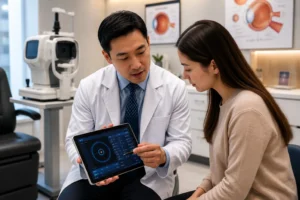
“Can an Eye Checkup Machine Detect All Eye Problems?”
No. An eye checkup machine such as an autorefractor is designed mainly to measure refractive error and focusing ability.
It does not replace a complete eye examination that evaluates conditions such as:
- Glaucoma
- Cataracts
- Retinal diseases
- Corneal problems
- Dry eye conditions
A comprehensive eye exam combines technology with an ophthalmologist’s clinical experience.
“Is an Autorefractor Eye Test Accurate?”
An autorefractor eye test provides a reliable starting measurement for many patients. However, the final interpretation depends on the ophthalmologist reviewing the results.
Factors such as:
- Eye movement
- Dry eyes
- Accommodation (natural focusing changes)
- Patient cooperation
can influence measurements.
This is why professional evaluation remains important when determining a final prescription or treatment plan.
“Does an Autorefractor Test Hurt?”
No. The test is completely non-invasive.
Patients simply look into the machine while measurements are taken. There is no touching of the eye and most people complete the test within seconds.
Frequently Asked Questions About Autorefractor Eye Test
What is an autorefractor eye test used for?
An autorefractor eye test is used to measure how the eye focuses light and estimate refractive errors such as nearsightedness, farsightedness, and astigmatism. It helps ophthalmologists understand a patient’s vision needs before completing additional testing.
What is an auto refractometer?
An auto refractometer is a computerized eye testing device that measures how light enters and reflects through the eye. It provides an estimate of the prescription required to correct vision problems.
Is an autorefractor the same as an eye exam?
No. An autorefractor is only one part of an eye examination. A complete eye exam includes additional tests that evaluate eye health, eye pressure, the retina, cornea, and other important structures.
How long does an autorefractor eye test take?
Most autorefractor measurements take only a few seconds per eye. The entire process is quick and comfortable for most patients.
Can children have an autorefractor eye test?
Yes. An autorefractor can be helpful when examining children because it provides objective measurements that may assist doctors in identifying vision problems.
What does an autorefractor image look like?
An autorefractor image is usually a simple target displayed inside the machine. Patients look at this image while the device measures how their eyes focus light.
Can an autorefractor detect glaucoma?
No. An autorefractor mainly measures refractive error. Glaucoma requires different evaluations, including eye pressure measurement, optic nerve examination, and other diagnostic testing.
Do I still need glasses testing after an autorefractor test?
Yes. The autorefractor provides an initial measurement, but the ophthalmologist may perform additional vision testing to refine the prescription and ensure it matches your visual needs.
Is an autorefractor eye test covered by insurance?
Coverage depends on your insurance plan and the type of eye examination being performed. Patients should confirm benefits with their insurance provider and eye care office.
Where can I get an autorefractor eye test in Flushing, Queens, NYC?
Patients looking for professional eye evaluation in Flushing, Queens can visit LeeVision, where advanced diagnostic technology is combined with personalized ophthalmology care under the guidance of Dr. David H. Lee, MD, a Board-Certified Ophthalmologist.
Final Thoughts: Why Professional Eye Evaluation Matters
An autorefractor eye test is an important advancement in modern eye care, helping ophthalmologists quickly understand how the eyes focus light and identify possible vision correction needs.
However, the best eye care combines technology with medical expertise. A machine can provide measurements, but an experienced ophthalmologist understands how those measurements relate to a patient’s symptoms, lifestyle, and long-term eye health.
At LeeVision in Flushing, Queens, NYC, Dr. David H. Lee, MD provides comprehensive ophthalmology care using advanced diagnostic technology and personalized treatment planning to help patients protect their vision at every stage of life.