




Blurred or distorted vision does not always mean you need a stronger glasses prescription. For many people, the underlying issue is eye astigmatism, a common refractive error that can affect both near and distance vision.
People often notice that straight lines look slightly distorted, headlights seem to have glare or streaks, or their eyes feel tired after reading or spending long hours in front of a screen. Mild cases may cause few noticeable symptoms, while more significant astigmatism can interfere with everyday activities.
This guide explains what eye astigmatism actually means, why it happens, how doctors diagnose it, and whether astigmatism exercise or other exercises to improve astigmatism can genuinely change the condition.
What Is Eye Astigmatism?
Eye astigmatism occurs when the cornea—the clear front surface of the eye—or, less commonly, the natural lens has an uneven shape. Instead of light focusing to a single precise point on the retina, it may focus in different directions.
The result can be blurred, hazy, or distorted vision at multiple distances. Unlike nearsightedness, which primarily affects distance vision, astigmatism can make both near and far objects appear unclear.
A useful way to picture it is to compare a normally shaped cornea with the shape of a basketball and an astigmatic cornea with a football. The analogy is not perfect anatomically, but it helps explain why light may bend differently across different meridians of the eye.
What Causes Eye Astigmatism?
There is not always one identifiable cause. Some people are born with it, while others develop changes during childhood or early adulthood. It can also occur after certain eye injuries or surgeries.
Importantly, eye astigmatism is not caused simply by reading in poor light, sitting too close to a screen, or using your eyes extensively. These activities may contribute to temporary visual discomfort, but they do not reshape a normally formed cornea into astigmatism.
Common Symptoms of Eye Astigmatism

The symptoms can vary considerably from one person to another. Some patients have mild astigmatism and notice almost nothing, while others experience persistent visual discomfort.
Common symptoms include:
- Blurred or distorted vision
- Difficulty seeing clearly at night
- Headaches after prolonged visual tasks
- Eye strain or tired eyes
- Frequent squinting
- Glare or halos around lights
- Difficulty maintaining clear focus
The National Eye Institute notes that mild astigmatism may produce no obvious symptoms, which is one reason comprehensive eye examinations remain important.
For patients in Flushing, Queens, NYC, long periods of computer and smartphone use can make an existing refractive error feel more noticeable. Screen-heavy work does not necessarily cause the astigmatism itself, but reduced blinking, dry eyes, and prolonged focusing can make blurred vision and eye fatigue more bothersome.
Can Astigmatism Exercise Improve Vision?
This is one of the most common questions patients ask: Can an astigmatism exercise actually correct the shape of the cornea?
In general, no.
There is currently no established eye exercise that can permanently reshape the cornea or natural lens and eliminate refractive eye astigmatism. Exercises may be useful for certain other visual conditions, but they should not be presented as a proven way to correct corneal astigmatism.
Likewise, popular searches for exercises to improve astigmatism can create unrealistic expectations. Moving the eyes in different directions, focusing on objects at different distances, or repeatedly blinking may temporarily reduce visual fatigue for some people, but these activities do not correct the underlying optical problem.
Why Do Eye Exercises Sometimes Seem to Help?
There is an important distinction between visual comfort and refractive correction.
If someone spends several hours looking at a computer, their eyes may become dry or fatigued. Taking breaks, blinking regularly, adjusting screen distance, and following sensible screen habits can improve comfort.
But if an eye examination shows true astigmatism, these habits do not replace an appropriate optical correction.
This distinction is especially important when patients search for an astigmatism exercise because they hope to avoid glasses or contact lenses. The safest approach is to determine first whether the blurred vision is actually caused by astigmatism, dry eye, another refractive error, or a different eye condition.
How Is Eye Astigmatism Diagnosed?
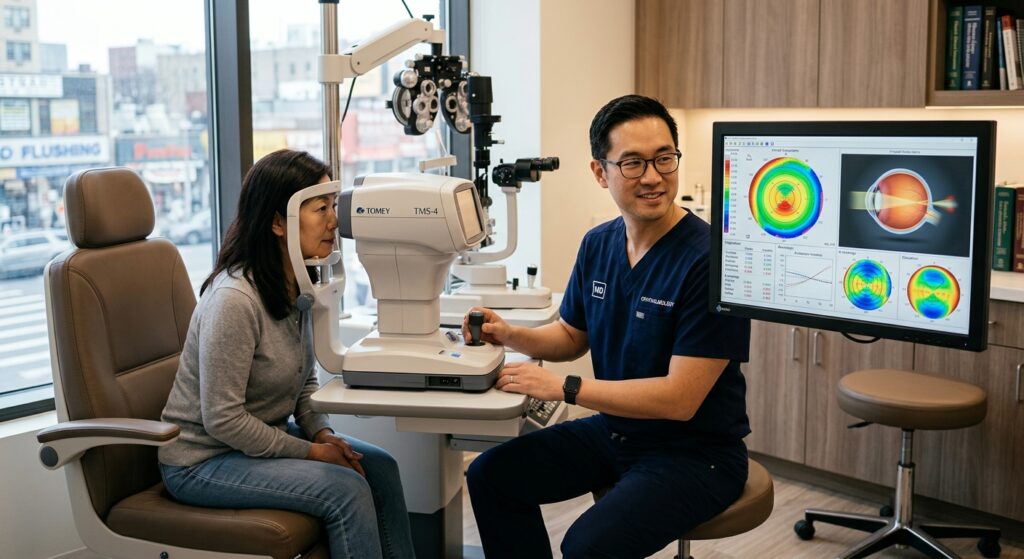
An eye doctor can identify astigmatism during a comprehensive eye examination. Refraction helps determine the prescription needed to bring images into clearer focus, while other measurements can evaluate the cornea and overall health of the eye.
Depending on the patient, an ophthalmologist may assess:
- Visual acuity
- Refraction
- Corneal curvature
- Eye pressure
- Overall ocular health
- The retina and optic nerve
- Tear-film and ocular-surface health when symptoms suggest dry eye
This broader evaluation matters because not every patient with blurred vision has the same problem.
What Are the Treatment Options?
Treatment depends on the amount and type of astigmatism, the patient’s age, eye health, lifestyle, and visual goals.
Eyeglasses
For many people, glasses remain the simplest and most predictable option. Special cylindrical correction is incorporated into the prescription to compensate for the uneven focusing power of the eye.
Contact Lenses
Toric contact lenses are designed specifically to correct astigmatism. In selected patients, other specialized lenses may be considered depending on the corneal shape and degree of irregularity.
Contact lenses can provide excellent vision, but proper fitting, hygiene, and follow-up are essential.
Refractive Surgery
For appropriately selected adults, procedures such as LASIK, PRK, or other refractive surgery approaches may correct certain forms of astigmatism by changing the corneal shape. Candidacy requires a detailed examination rather than simply looking at the glasses prescription.
Surgery is not automatically the best choice. Corneal thickness, surface health, prescription stability, eye anatomy, expectations, and overall ocular health all matter.
When Should You Have Your Eyes Examined?
If blurred vision persists, your prescription seems to be changing, night driving becomes difficult, or headaches and eye strain repeatedly occur, an eye examination is worthwhile.
A particularly important point is that eye astigmatism can coexist with myopia, hyperopia, dry eye, or other eye conditions. Treating the correct cause is more useful than simply trying an online exercise.
At LeeVision, Dr. David H. Lee, MD, a board-certified ophthalmologist, approaches vision concerns by looking at the entire eye rather than assuming every complaint is simply a glasses problem. The goal is accurate diagnosis, appropriate correction, and long-term protection of vision.
Eye Astigmatism: Understanding Severity, Vision Changes, and Treatment Choices

Not every case of eye astigmatism affects vision in the same way. Some people have a small amount that is discovered during a routine examination, while others have enough distortion to make reading, driving, computer work, or recognizing faces more difficult.
Understanding the degree of astigmatism is often more useful than simply asking whether you have it.
How Severe Can Eye Astigmatism Be?
Astigmatism is generally described according to the amount of cylindrical correction needed in a glasses or contact lens prescription. The exact effect on vision varies because people adapt differently to changes in focusing.
| Level | What patients may notice | Typical approach |
|---|---|---|
| Mild | Little or occasional blur | Observation or glasses if needed |
| Moderate | Noticeable blur, strain, glare | Glasses or contact lenses |
| Higher | Persistent distortion and reduced clarity | Optical correction and detailed evaluation |
| Irregular | Distortion that may not correct normally with glasses | Specialized evaluation and treatment |
There is no single prescription number that determines whether someone’s symptoms are “mild” or “severe.” Your ophthalmologist considers the prescription alongside visual acuity, corneal shape, symptoms, and the health of the eye.
Why Can Astigmatism Make Night Vision Difficult?
One of the complaints I hear during eye consultations is that patients can see reasonably well during the day but struggle with headlights and streetlights at night.
Eye astigmatism can contribute to glare, halos, streaking, or ghost-like images around lights. However, these symptoms are not exclusive to astigmatism. Dry eye, an outdated prescription, contact lens problems, cataracts, and other optical issues can produce similar complaints.
For patients who drive frequently in New York City, even a relatively modest amount of visual distortion can become more noticeable when there are bright headlights, illuminated signs, and reflections from wet roads.
A comprehensive examination helps identify the actual cause instead of assuming that astigmatism is responsible for every nighttime vision complaint.
Can Children Have Eye Astigmatism?
Yes. Children can develop or be born with astigmatism, and they may not realize that their vision is abnormal because they have never experienced anything different.
A child may not say, “My vision is blurry.” Instead, parents or teachers may notice:
- Squinting
- Sitting unusually close to screens
- Difficulty reading
- Headaches
- Losing place while reading
- Avoiding visually demanding activities
- Poor attention during schoolwork
Early detection matters because significant uncorrected refractive errors during childhood can interfere with normal visual development.
Parents in Flushing, Queens, NYC should consider a professional eye evaluation if a child consistently struggles with schoolwork or visual tasks, particularly when teachers or caregivers notice a change.
Can Eye Astigmatism Get Worse?
The answer is more complicated than simply saying yes or no.
A glasses prescription can change over time, particularly during childhood and young adulthood. Changes in the cornea can also occur with certain eye conditions.
For example, progressive corneal disorders such as keratoconus can produce increasing or irregular astigmatism. This is different from ordinary, stable eye astigmatism and may require specialized corneal testing.
A sudden or substantial change in vision should therefore not be managed by repeatedly ordering stronger glasses without determining why the prescription has changed.
Can an Astigmatism Exercise Remove Astigmatism?
No proven astigmatism exercise has been shown to permanently correct the corneal shape responsible for ordinary refractive astigmatism.
This is an important distinction because many websites promote exercises to improve astigmatism as though eye movement can reshape the cornea. There is not good clinical evidence that these exercises eliminate refractive astigmatism.
That does not mean eye breaks are useless.
If your eyes are tired after prolonged screen use, taking regular breaks, blinking frequently, maintaining an appropriate viewing distance, and addressing dry eye can make your eyes feel more comfortable.
But improved comfort is not the same as correcting the optical error.
Glasses vs Contact Lenses for Astigmatism

Both options can provide excellent vision, but the better choice depends on lifestyle and eye health.
| Glasses | Contact lenses |
|---|---|
| Easy to use | Less visible correction |
| Minimal eye-contact risk | Wider field of vision |
| Simple maintenance | Require careful hygiene |
| Useful for dry or sensitive eyes | May be uncomfortable with dry eye |
| Easy prescription adjustment | Require proper fitting |
Toric contact lenses are commonly used when the amount and type of astigmatism can be appropriately corrected with a contact lens.
Patients with significant dry eye, allergies, irregular corneal surfaces, or difficulty maintaining contact-lens hygiene may be better suited to glasses.
Does Astigmatism Always Need Treatment?
Not necessarily.
A small amount of eye astigmatism may not require correction if vision is clear and the patient has no meaningful symptoms. Treatment decisions should be based on how the refractive error affects vision and daily life—not simply on the existence of a number on a prescription.
For children, however, the decision can be different because clear vision is important for normal visual development.
When Is Refractive Surgery Considered?
Adults who are tired of glasses or contact lenses may ask whether LASIK or another refractive procedure can correct astigmatism.
In appropriately selected patients, corneal refractive surgery can correct certain types of astigmatism. However, a consultation should assess more than the prescription.
An ophthalmologist may evaluate:
- Corneal thickness
- Corneal topography or tomography
- Tear-film health
- Prescription stability
- Pupil characteristics
- Overall eye health
- Expectations and lifestyle
LASIK, PRK, and other procedures have potential benefits and risks. They are not suitable for everyone, and no responsible ophthalmologist should promise perfect vision.
Common Questions Patients Ask About Eye Astigmatism
Can exercises to improve astigmatism replace glasses?
No. Exercises to improve astigmatism have not been established as a replacement for glasses, contact lenses, or medically appropriate refractive treatment.
Does an astigmatism exercise improve eyesight?
An astigmatism exercise may sometimes be promoted for visual comfort, but it does not correct the underlying corneal shape responsible for refractive astigmatism.
Can eye astigmatism disappear naturally?
Small prescription changes can occur, but ordinary astigmatism should not be expected to disappear simply through eye exercises or lifestyle changes.
Is eye astigmatism the same as blurry vision?
No. Eye astigmatism is one possible cause of blurry or distorted vision. Nearsightedness, farsightedness, dry eye, cataracts, corneal conditions, and retinal problems can also cause blurred vision.
Why do I see streaks around lights?
Astigmatism can contribute to streaking and glare, but dry eye and other optical conditions can produce similar symptoms. A comprehensive eye examination can help identify the cause.
Is eye astigmatism serious?
Most ordinary astigmatism is a common refractive condition and is readily managed. However, rapidly changing or irregular astigmatism deserves further evaluation because it can sometimes indicate an underlying corneal problem.
Can children outgrow eye astigmatism?
A child’s prescription can change as the eyes develop, but parents should not assume that significant astigmatism will simply disappear. Appropriate eye examinations help determine whether correction is necessary.
Can screen time cause eye astigmatism?
Ordinary screen use does not directly create corneal astigmatism. However, prolonged screen use can contribute to dryness and eye fatigue, which may make existing visual problems feel worse.
Should I try exercises to improve astigmatism before seeing an eye doctor?
No. If vision is persistently blurry or distorted, an eye examination is more useful than relying on exercises to improve astigmatism. The first step is confirming what is actually causing the visual problem.
Can contact lenses correct eye astigmatism?
Yes. Toric contact lenses can correct many forms of regular astigmatism when properly prescribed and fitted.
Can LASIK correct eye astigmatism?
For appropriately selected patients, LASIK can correct certain amounts and types of astigmatism. Candidacy must be determined through a detailed examination of the cornea and overall eye health.
Does eye astigmatism cause headaches?
It can contribute to headaches or visual fatigue, particularly when the refractive error is uncorrected. However, headaches have many possible causes, so they should not automatically be attributed to astigmatism.
Eye Astigmatism: Treatment, Prevention, and When to See an Eye Doctor
For most patients, eye astigmatism is manageable once the cause and degree of the refractive error are understood. The right treatment depends on how much it affects vision, whether the cornea is regular or irregular, and whether other problems such as dry eye or cataracts are also present.
Choosing the Right Treatment for Eye Astigmatism
The simplest treatment is often the best one. Glasses can correct regular astigmatism accurately and remain an excellent option for children, adults, and patients who prefer a low-maintenance solution.
Toric contact lenses may be appropriate for people who want correction without glasses. They require proper fitting and careful hygiene, particularly for patients who experience dry eye or allergies.
For selected adults, refractive surgery may be considered. Procedures such as LASIK or PRK can correct certain forms of eye astigmatism, but suitability depends on corneal measurements, prescription stability, tear-film health, and overall eye health.
Eye Astigmatism and Dry Eye
Dry eye deserves special attention because it can make vision fluctuate even when the glasses prescription is correct.
Patients who spend many hours working on computers or smartphones may blink less frequently. This can destabilize the tear film and temporarily make vision appear blurry.
In these situations, an ophthalmologist should determine whether the visual complaint is coming from eye astigmatism, dry eye, or both.
Can Astigmatism Be Prevented?
Most ordinary astigmatism cannot be prevented because corneal shape is influenced by eye development and individual anatomy.
However, protecting overall eye health remains important. Patients should have appropriate eye examinations, wear recommended protective eyewear when necessary, follow contact-lens hygiene instructions, and seek evaluation when vision changes.
An astigmatism exercise cannot prevent the cornea from developing an irregular shape, and there is no established program of exercises to improve astigmatism that can replace medical correction.
When Should You See an Ophthalmologist?
An examination becomes particularly important when:
- Vision suddenly becomes blurry
- Your prescription changes repeatedly
- Night driving becomes difficult
- You develop persistent headaches with visual tasks
- One eye sees substantially differently from the other
- Contact lenses suddenly become uncomfortable
- Straight lines appear unusually distorted
- Vision remains blurry despite updated glasses
Rapidly changing or irregular astigmatism deserves particular attention because it can sometimes be associated with corneal conditions requiring additional testing.
At LeeVision in Flushing, Queens, NYC, Dr. David H. Lee, MD, a board-certified ophthalmologist, can evaluate refractive errors alongside the health of the cornea, ocular surface, retina, and other structures of the eye. The goal is not simply to provide a stronger prescription but to understand why vision is changing and select an appropriate treatment.
Frequently Asked Questions About Eye Astigmatism
Can eye astigmatism be cured?
Eye astigmatism can often be corrected very effectively with glasses or contact lenses. Selected patients may also qualify for refractive surgery. However, treatment choice depends on the individual’s eyes and should follow a professional examination.
Do exercises to improve astigmatism really work?
There is no strong clinical evidence that exercises to improve astigmatism permanently reshape the cornea or eliminate ordinary refractive astigmatism.
Is an astigmatism exercise safe?
Simple eye-movement exercises are generally not a treatment for refractive astigmatism. An astigmatism exercise should not be used as a substitute for an eye examination when vision is persistently blurred.
Can exercises to improve astigmatism reduce glasses power?
There is no established evidence that exercises to improve astigmatism can reliably reduce cylindrical prescription power. If your prescription has changed, an eye examination is the appropriate way to determine why.
Can eye astigmatism improve naturally?
The prescription can change as the eyes develop, particularly during childhood. However, patients should not expect ordinary eye astigmatism to disappear because of exercise, diet, or reduced screen time.
Does eye astigmatism cause blurry vision?
Yes. Eye astigmatism can produce blurred, hazy, or distorted vision at both near and far distances. The degree of blur depends on the amount and type of astigmatism and whether another eye condition is present.
Can eye astigmatism cause eye strain?
Yes. Uncorrected refractive errors may contribute to visual fatigue, particularly during reading, computer work, or other prolonged focusing tasks. However, eye strain can also result from dry eye and excessive screen use.
Can eye astigmatism cause headaches?
It can contribute to headaches associated with prolonged visual effort, but headaches have many possible causes. Persistent headaches should not automatically be attributed to eye astigmatism.
Why is my eye astigmatism worse at night?
Some patients notice glare, halos, streaking, or reduced clarity around headlights at night. Astigmatism can contribute, although dry eye, pupil size, cataracts, and other optical factors may also play a role.
Can children have eye astigmatism?
Yes. Children can have eye astigmatism without realizing that their vision is abnormal. Regular pediatric eye examinations are important because significant uncorrected refractive errors can interfere with visual development.
Does screen time cause eye astigmatism?
Normal screen use does not directly cause corneal astigmatism. However, prolonged screen exposure can worsen dryness and temporary eye fatigue, making existing eye astigmatism feel more noticeable.
Can contact lenses fix eye astigmatism?
Toric contact lenses are specifically designed to correct many cases of regular eye astigmatism. Proper fitting is important because the lens must maintain the correct orientation on the eye.
Can LASIK fix eye astigmatism?
LASIK can correct certain forms and amounts of eye astigmatism in appropriately selected patients. A detailed corneal evaluation is necessary before deciding whether LASIK is suitable.
Is eye astigmatism dangerous?
Most regular astigmatism is a common refractive condition rather than a dangerous eye disease. However, rapidly changing or irregular astigmatism should be investigated to exclude underlying corneal problems.
Can an astigmatism exercise replace glasses?
No. An astigmatism exercise does not provide the optical correction supplied by properly prescribed glasses or contact lenses.
How often should I have my eyes checked?
The appropriate interval depends on age, symptoms, medical history, risk factors, and previous examination findings. Anyone experiencing a significant change in vision should arrange an examination rather than waiting for a routine appointment.
What are the best exercises to improve astigmatism?
There is no medically established set of exercises to improve astigmatism that corrects the underlying refractive error. Eye breaks and comfortable visual habits can support eye comfort, but they should not be confused with treatment.
Can eye astigmatism get worse with age?
A prescription can change throughout life. New or rapidly increasing astigmatism later in life should be evaluated rather than automatically assumed to be normal aging.
Should I worry if my eye astigmatism suddenly changes?
A sudden prescription change deserves professional evaluation. The ophthalmologist may need to examine the cornea more closely to determine whether the change is simply refractive or related to another condition.
What is the most effective treatment for eye astigmatism?
There is no single best treatment for everyone. Glasses, toric contact lenses, and refractive surgery can all have an appropriate role. The best choice depends on the patient’s visual needs, eye health, lifestyle, and treatment goals.
