

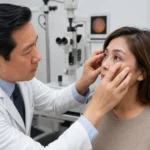


Eye Drops for Presbyopia: What Patients Should Know in 2026
Presbyopia is one of the most common vision changes associated with aging. It gradually makes it harder to read a phone, menu, book, prescription label, or other close-up material without holding it farther away. The condition is usually noticeable after age 40 and happens because the eye’s natural lens becomes less flexible and has more difficulty changing focus for near vision.
For years, the most familiar solutions were reading glasses, bifocals, progressive glasses, and contact lenses. Today, patients have another option to discuss with an eye doctor: eye drops for presbyopia. Several prescription drops are now FDA-approved for adults with presbyopia, making medication-based near-vision treatment a genuine option rather than an experimental concept.
However, these drops are not a replacement for a complete eye examination, and they are not appropriate for everyone. The right choice depends on your age, prescription, eye health, lifestyle, and what you expect from treatment.
What Is Presbyopia?
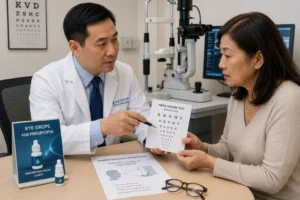
Presbyopia is different from ordinary nearsightedness. With presbyopia, the main problem is the eye’s declining ability to focus on nearby objects.
You may notice that:
- Small print looks blurry at your normal reading distance.
- You need brighter light to read comfortably.
- You hold your phone or book farther away.
- Your eyes feel tired after prolonged close-up work.
- You experience headaches or eye strain when reading.
These symptoms can become especially noticeable for people who spend long hours using phones, laptops, and other screens. For patients in Flushing, Queens, NYC, a screen-heavy workday combined with commuting, indoor heating or air conditioning, and seasonal allergies can also make visual discomfort more noticeable.
Presbyopia itself is a normal age-related change, but new or rapidly changing vision should not automatically be blamed on presbyopia. A comprehensive eye examination can help determine whether another eye condition is contributing to blurred vision.
How Do Eye Drops for Presbyopia Work?

Modern presbyopia drops generally work by changing the way light enters the eye and improving the eye’s ability to focus on nearby objects.
Some prescription drops contain medications that temporarily make the pupil smaller. This creates a pinhole effect, increasing depth of focus so that near objects may appear clearer. Other formulations work through different pharmacologic mechanisms designed to improve near vision while maintaining useful distance vision.
As of 2026, FDA-approved prescription options include medications such as VUITY (pilocarpine hydrochloride ophthalmic solution 1.25%), QLOSI (pilocarpine hydrochloride ophthalmic solution 0.4%), and VIZZ (aceclidine ophthalmic solution 1.44%) for the treatment of presbyopia in adults. VIZZ received FDA approval on July 31, 2025.
That does not mean one drop is automatically better than another. Medication choice should be individualized after an eye examination and discussion of the potential benefits, limitations, and side effects.
What Can Patients Realistically Expect?
The biggest misconception is that presbyopia eye drops permanently restore the eye’s youthful focusing ability.
They do not.
These medications provide a temporary optical or pharmacologic improvement in near vision rather than permanently reversing the age-related changes in the natural lens. The effect can vary between patients, and some people may still need reading glasses for certain tasks.
This distinction matters when deciding whether drops fit your lifestyle. Someone who mainly wants to read a restaurant menu, check a phone, or look at a computer screen without immediately reaching for glasses may value temporary improvement. Another patient who wants consistently sharp vision for reading, driving, and computer work may prefer another correction strategy.
Are Presbyopia Eye Drops Safe?
Prescription eye drops should be used only after an eye-care professional determines that they are appropriate for you.
Depending on the medication, patients may experience temporary visual changes, eye irritation, headache, or other side effects. Some drops can also affect vision in dim lighting, which is important for anyone who drives at night or frequently works in low-light environments. The FDA prescribing information for VIZZ, for example, specifically warns that temporary dim or dark vision can occur after application.
Patients should also understand that having presbyopia does not automatically make them a candidate for every medication. Your ophthalmologist may need to consider your overall ocular health, current medications, previous eye procedures, and the quality of your distance vision before recommending treatment.
Multifocal Contact Lenses for Presbyopia
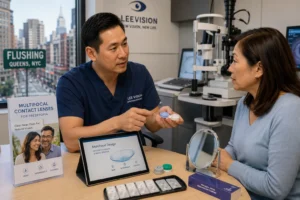
Eye drops are only one part of the presbyopia treatment conversation. Multifocal contact lenses for presbyopia are another non-surgical option for patients who want correction without wearing glasses.
These lenses are designed to provide vision at more than one distance. The National Eye Institute notes that multifocal contact lenses can help people who have both presbyopia and another refractive error, such as nearsightedness, with tasks including reading and driving.
Contact lenses can be attractive for active adults who dislike switching between distance glasses and reading glasses. On the other hand, they require proper fitting, hygiene, and tolerance of wearing a lens directly on the eye. Some patients also experience dryness or reduced comfort, particularly during prolonged screen use.
Do They Make Progressive Contact Lenses?
Patients often ask, “Do they make progressive contact lenses?”
The answer is slightly more complicated than simply saying yes.
Contact lenses do not work exactly like progressive eyeglasses, which have distinct areas for distance, intermediate, and near vision. Multifocal contact lenses use specialized optical designs to provide access to different focal ranges while the lens remains on the eye.
The result can be very useful, but the visual experience is different from wearing progressive glasses. Some patients adapt quickly, while others notice compromises in contrast, low-light vision, or extremely fine near detail. A proper fitting and realistic expectations are therefore important.
For a patient considering treatment in Flushing, Queens, the best option may not be the newest option. A thorough evaluation at an ophthalmology practice such as LeeVision can help determine whether eye drops, multifocal contact lenses, glasses, or another approach makes the most sense for the individual’s eyes and daily visual demands.
Choosing the Right Presbyopia Treatment

There is no single “best” treatment for presbyopia because people use their near vision differently. Someone who mainly wants to read messages on a phone may make a different choice from someone who spends eight hours a day on a computer, frequently drives at night, or wants to avoid glasses altogether.
The goal of treatment is not simply to make small print clearer. It is to find a balance between near vision, intermediate vision, distance vision, comfort, safety, and lifestyle.
Eye Drops vs Reading Glasses
Reading glasses remain one of the simplest and most predictable ways to manage presbyopia. They do not require medication, contact lens care, or a procedure, and they can provide very clear near vision when properly prescribed. The National Eye Institute lists glasses and contact lenses among the standard approaches for treating presbyopia.
The main disadvantage is convenience. You have to put them on when you need them, carry them with you, and remove them for tasks where you want normal distance vision.
Presbyopia eye drops offer a different approach. Rather than placing an optical correction in front of the eyes, the medication temporarily changes the eye’s optical behavior to improve near vision. FDA-approved drops are prescription treatments for adults with presbyopia, but their effect is temporary and their suitability depends on the individual patient.
For some patients, that convenience may be appealing. For others, the predictability and simplicity of glasses may still make them the better everyday solution.
Eye Drops vs Multifocal Contact Lenses
Multifocal contact lenses for presbyopia are particularly useful for people who want correction across more than one viewing distance without wearing glasses.
Unlike reading glasses, multifocal contacts remain on the eyes throughout the day. Depending on the lens design and the patient’s eyes, they may provide functional vision for distance, intermediate activities, and near tasks. The National Eye Institute specifically recognizes multifocal contact lenses as an option for people with presbyopia who also have refractive errors such as myopia.
However, contact lenses introduce considerations that eye drops do not. Proper fitting, hygiene, lens tolerance, tear-film quality, and wearing habits all matter. Patients with dry eye symptoms may find contact lens wear less comfortable, particularly during long periods of computer or phone use.
This is one reason an eye examination should come before choosing between drops and contact lenses rather than simply selecting the newest option available.
Do They Make Progressive Contact Lenses?
This is one of the most common points of confusion.
Patients sometimes imagine that a progressive contact lens works exactly like a progressive eyeglass lens, with a visible progression from distance to near. Contact lenses use different optical designs.
Multifocal contact lenses distribute optical power within the lens so that the wearer can access different focal distances. Some designs use concentric zones, while others use different approaches to create an extended range of vision. FDA records include multiple contact lens products specifically indicated for presbyopia.
So, when someone asks, “Do they make progressive contact lenses?”, the practical answer is that there are contact lenses designed to address presbyopia, but they should generally be understood as multifocal or presbyopia-correcting contact lenses, not simply progressive glasses placed on the eye.
The visual result can also feel different from progressive eyeglasses. Some patients adapt very well, while others notice differences in contrast, night vision, or fine-detail performance.
When Presbyopia Drops May Not Be the Best Choice
A medication can be FDA-approved without being appropriate for every patient.
An ophthalmologist may look closely at the health of the cornea, lens, retina, optic nerve, and other structures before recommending a treatment. Existing eye disease, previous eye surgery, medications, and the patient’s visual demands can all influence the decision.
For example, someone who already struggles with significant ocular surface dryness may need the dry eye problem addressed before trying contact lenses. Likewise, a patient experiencing unexplained changes in vision should not assume that presbyopia is the only issue.
There is also an important safety consideration with some presbyopia drops. Medication that changes pupil size can affect vision in low-light conditions, and product labeling includes warnings about temporary dim or dark vision with VIZZ. Patients who regularly drive at night should discuss this specifically with their ophthalmologist.
What About LASIK or Other Eye Surgery?

Patients sometimes ask whether LASIK can permanently eliminate presbyopia.
LASIK reshapes the cornea to correct refractive errors, but it does not stop the natural age-related loss of lens flexibility responsible for presbyopia. The National Eye Institute notes that because everyone eventually develops presbyopia, people who undergo LASIK may still need reading correction as they age.
For selected patients with other age-related changes, different surgical options may be discussed. These can include procedures involving the natural lens or presbyopia-correcting intraocular lenses, particularly when cataract surgery is also appropriate. These are very different decisions from simply using presbyopia eye drops and require a detailed examination and discussion of benefits, limitations, risks, and alternatives.
The important point is that surgery should never be selected simply because a patient wants to get rid of reading glasses. The health of the eye and the patient’s long-term visual goals matter more than the appeal of being glasses-free.
When Should You Have Your Vision Checked?
Blurred near vision that develops gradually is often consistent with presbyopia, but a proper examination is still valuable.
An eye doctor can determine whether the problem is simply age-related focusing difficulty or whether another issue, such as a refractive error, cataract, dry eye disease, retinal condition, or other eye problem, is affecting vision.
An evaluation is especially important when blurry vision is sudden, significantly different between the two eyes, associated with eye pain, flashes, a sudden increase in floaters, or a noticeable loss of vision.
For patients in Flushing, Queens, NYC, an ophthalmology evaluation can also be a useful opportunity to discuss how work, screen use, commuting, contact lens wear, and night driving affect their visual needs. At LeeVision, the treatment discussion should center on the patient’s actual eye health and daily visual demands rather than choosing treatment based solely on a search result.
The Most Important Question Is Not “Which Treatment Is Newest?”
Modern presbyopia treatment gives patients more choices than they had in the past. Prescription eye drops, reading glasses, multifocal contact lenses, and selected surgical approaches can all have a role.
But more options do not necessarily make the decision easier.
A good treatment plan considers how much near vision you need, how important distance vision is, whether you tolerate contact lenses, whether your eyes are healthy enough for a particular medication or procedure, and how much inconvenience you are willing to accept.
That is why a personalized examination remains the starting point. The most useful treatment is the one that fits both the patient’s eyes and the way that patient actually uses vision every day.
Frequently Asked Questions About Eye Drops for Presbyopia
What are eye drops for presbyopia?
Eye drops for presbyopia are prescription medications designed to temporarily improve near vision in adults who have age-related difficulty focusing on close objects. Different medications use different mechanisms, so an ophthalmologist should determine whether eye drops for presbyopia are appropriate for you.
Do eye drops for presbyopia really work?
For appropriately selected adults, prescription eye drops for presbyopia can improve functional near vision. They do not permanently reverse the age-related changes that cause presbyopia, and the amount of improvement can vary from person to person.
Are there FDA-approved eye drops for presbyopia in 2026?
Yes. FDA-approved prescription options include QLOSI, VIZZ, and YUVEZZI for adults with presbyopia. VIZZ was approved in July 2025, while the FDA approved YUVEZZI in January 2026.
What is the newest eye drop for presbyopia?
YUVEZZI is one of the newer prescription eye drops for presbyopia, receiving FDA approval in January 2026. It contains carbachol and brimonidine tartrate and is indicated for the treatment of presbyopia in adults.
Is VIZZ still an option for presbyopia?
Yes. VIZZ is an FDA-approved prescription eye drop containing aceclidine ophthalmic solution 1.44% for treating presbyopia in adults. Its approval date was July 31, 2025.
Is QLOSI used for presbyopia?
Yes. QLOSI contains pilocarpine hydrochloride ophthalmic solution 0.4% and is indicated for the treatment of presbyopia in adults. It is another prescription option patients may discuss with their ophthalmologist.
Can eye drops for presbyopia replace reading glasses?
Sometimes eye drops for presbyopia may reduce how often a patient needs reading glasses, but they should not be considered a guaranteed permanent replacement. Some patients may still prefer glasses for prolonged reading, detailed work, or situations requiring maximum near clarity.
How long do eye drops for presbyopia last?
The duration depends on the specific medication. Different eye drops for presbyopia have different dosing instructions and durations of effect. For example, VIZZ is labeled for once-daily use, while YUVEZZI is also prescribed once daily.
Are eye drops for presbyopia a permanent cure?
No. Eye drops for presbyopia do not restore the flexibility that the natural lens loses with age. They provide a temporary treatment effect rather than reversing the underlying aging process of the eye.
Are eye drops for presbyopia safe?
FDA-approved eye drops for presbyopia have undergone clinical evaluation, but like other prescription medications, they can cause side effects and are not suitable for every patient. Your ophthalmologist should review your eye health, medications, symptoms, and visual requirements before recommending treatment.
Can eye drops for presbyopia cause blurry vision?
Some patients may experience temporary visual changes after using prescription eye drops for presbyopia. The exact side effects depend on the medication. VIZZ labeling, for example, includes temporary dim or dark vision among its warnings.
Can I drive after using eye drops for presbyopia?
You should understand how your prescribed medication affects your vision before driving. Some eye drops for presbyopia may temporarily affect vision, particularly in low-light conditions. Patients who drive at night should discuss this specifically with their ophthalmologist.
Can I use eye drops for presbyopia if I have dry eyes?
Having dry eyes does not automatically rule out eye drops for presbyopia, but your ophthalmologist should assess your ocular surface first. Dry eye disease can affect visual quality and may also make contact lens wear less comfortable.
Are multifocal contact lenses for presbyopia better than eye drops?
Not necessarily. Multifocal contact lenses for presbyopia and eye drops solve the problem differently. Multifocal contacts provide optical correction while worn, whereas eye drops for presbyopia temporarily alter the eye’s optical function. The better choice depends on eye health, comfort, lifestyle, and visual expectations.
How do multifocal contact lenses for presbyopia work?
Multifocal contact lenses for presbyopia use specialized optical designs that provide access to more than one focal distance. They can help patients see at near and distance without constantly changing glasses, although adaptation and visual quality can differ between individuals.
Are multifocal contact lenses for presbyopia comfortable?
Many patients tolerate multifocal contact lenses for presbyopia well, but comfort depends on the individual. Tear-film quality, lens material, fitting, wearing time, allergies, dry eye symptoms, and screen use can all influence comfort.
Do multifocal contact lenses for presbyopia correct both distance and near vision?
Yes. Multifocal contact lenses for presbyopia are designed to provide useful vision across more than one distance. However, they may not provide exactly the same visual experience as separate distance and reading prescriptions.
Do they make progressive contact lenses?
Patients often ask, “Do they make progressive contact lenses?” There are contact lenses designed for presbyopia, usually described as multifocal or presbyopia-correcting contact lenses. They do not function exactly like progressive eyeglasses but are designed to provide vision across different focal distances.
Do they make progressive contact lenses for people over 40?
Yes, there are presbyopia-correcting contact lens options for adults who develop age-related near-vision problems. When patients ask “Do they make progressive contact lenses?”, they are usually asking about multifocal contact lenses for presbyopia. A proper fitting determines whether that type of lens is appropriate.
Are progressive contact lenses the same as multifocal contact lenses for presbyopia?
Not exactly. Do they make progressive contact lenses? is a common search question, but contact lenses use optical designs that differ from progressive eyeglasses. Multifocal contact lenses for presbyopia generally provide several focal ranges through specialized zones or optical designs.
Can I use multifocal contact lenses for presbyopia if I have dry eyes?
Possibly, but dry eye symptoms should be evaluated first. Multifocal contact lenses for presbyopia may become uncomfortable when the tear film is unstable, particularly during long computer sessions or heavy smartphone use.
What is better for computer work: eye drops or multifocal contact lenses for presbyopia?
There is no universal answer. A patient who spends many hours at a computer may need strong intermediate vision, while another patient may prioritize reading or distance vision. An eye examination can help determine whether eye drops for presbyopia, multifocal contact lenses for presbyopia, glasses, or another option fits those demands.
Can I use eye drops for presbyopia with contact lenses?
This depends on the specific medication. Some prescription eye drops for presbyopia have instructions concerning contact lens removal and reinsertion. Patients should follow the prescribing information for their particular medication rather than applying the same rule to every eye drop.
Can LASIK fix presbyopia permanently?
LASIK corrects certain refractive errors by reshaping the cornea, but it does not stop the natural aging process that causes presbyopia. A patient may still require near correction after LASIK, particularly as presbyopia progresses.
Is surgery better than eye drops for presbyopia?
Surgery and eye drops for presbyopia are fundamentally different treatment approaches. Surgery may be appropriate for selected patients with particular refractive or lens-related problems, while prescription drops provide a non-surgical temporary approach. The risks and benefits need to be evaluated individually.
Can cataract surgery also address presbyopia?
Cataract surgery removes the cloudy natural lens and replaces it with an intraocular lens. Depending on the patient’s eyes and the lens selected, cataract surgery may also reduce dependence on glasses at certain distances. It is not an appropriate treatment simply because someone has ordinary presbyopia without another indication for surgery.
When should I see an ophthalmologist for presbyopia?
You should arrange an eye examination if close-up vision is becoming difficult, your prescription is changing, reading has become uncomfortable, or you are considering eye drops for presbyopia or multifocal contact lenses for presbyopia.
An examination is particularly important if vision changes suddenly or are accompanied by pain, flashes, a sudden increase in floaters, distortion, or significant vision loss.
Can people in Flushing, Queens, get treatment for presbyopia?
Yes. Adults in Flushing, Queens, NYC, can discuss presbyopia treatment options with an ophthalmologist. At LeeVision, the evaluation can include discussion of eye drops for presbyopia, glasses, multifocal contact lenses for presbyopia, and other options according to the patient’s eye health and daily visual requirements.
What should I ask my eye doctor about eye drops for presbyopia?
Ask which prescription is appropriate for you, how long its effect is expected to last, possible side effects, whether it may affect night vision, how it fits with your existing medications or contact lenses, and whether another treatment would provide more predictable vision.
What is the best treatment for presbyopia in 2026?
There is no single best treatment for everyone. Eye drops for presbyopia, reading glasses, progressive glasses, multifocal contact lenses for presbyopia, and selected surgical options each have advantages and limitations. A personalized examination is the safest way to choose among them.
Should I choose eye drops or multifocal contact lenses for presbyopia?
The decision depends on what matters most to you. Eye drops for presbyopia may appeal to patients who want a temporary, non-contact-lens option, while multifocal contact lenses for presbyopia may be preferable for someone who wants correction throughout the day without wearing glasses.
The most useful approach is to compare the options with an ophthalmologist who can evaluate your eye health, prescription, tear film, lifestyle, and long-term vision goals.