




When people search for eye fitness, they often have a simple goal: they want their eyes to feel less tired and their vision to stay healthy for as long as possible. This is especially relevant today, when hours of computer work, smartphones, commuting, and close-up tasks have become part of everyday life.
But there is an important distinction between keeping your eyes healthy and actually changing the optical power of the eye. Certain habits and exercises may help reduce visual discomfort or improve specific focusing and eye-coordination problems, but they do not replace glasses, contact lenses, or medical treatment when those are needed.
For patients in Flushing, Queens, NYC, this distinction matters. A person spending most of the day on a computer may experience tired eyes for a very different reason than someone with an uncorrected prescription, dry eye disease, cataracts, glaucoma, or another underlying condition.
What Is Eye Fitness?
Eye fitness is not a medical diagnosis. It is a useful way to describe habits that support comfortable vision, healthy eyes, and good visual function.
A sensible approach includes:
- Taking regular breaks from prolonged screen work
- Blinking frequently during concentrated near work
- Maintaining good lighting and screen ergonomics
- Staying physically active and eating a balanced diet
- Wearing appropriate UV protection outdoors
- Using protective eyewear when there is a risk of eye injury
- Keeping recommended comprehensive eye examinations
- Addressing persistent dryness, headaches, blurred vision, or focusing difficulty
The National Eye Institute emphasizes that overall health plays an important role in protecting vision. Physical activity, healthy nutrition, smoking cessation, UV protection, and regular eye examinations can all contribute to long-term eye health.
Eye Fitness Is More Than Eye Exercises
One common misconception is that healthy eyes simply need a daily eye workout.
Your eyes are not muscles that can be trained in the same way as your arms or legs. Vision depends on the cornea, lens, retina, optic nerve, brain, eye movements, focusing system, and coordination between both eyes.
That means an eye improve exercise may be useful for a particular visual problem, but there is no universal exercise that can eliminate every refractive error or prevent every eye disease.
This is one reason an eye examination is important when vision changes persist.
Can Eye Exercises Improve Vision?
Sometimes—but the answer depends on why your vision is uncomfortable or reduced.
Certain exercises may be incorporated into treatment for specific binocular vision or focusing problems. These programs are usually selected after an eye-care professional identifies the underlying problem rather than simply prescribing random exercises.
For example, someone experiencing difficulty coordinating the eyes during prolonged near work may require a very different approach from someone whose blurred vision is caused by astigmatism or cataracts.
What Eye Exercises May Help With
Depending on the underlying problem, professionally guided exercises may help with aspects of:
- Eye coordination
- Convergence, meaning bringing both eyes together for near tasks
- Focusing flexibility
- Certain binocular vision difficulties
- Symptoms associated with prolonged near work
However, these exercises should not be presented as a cure for common eye diseases or as a way to permanently remove a glasses prescription.
Eye Fitness for Screen-Heavy Lifestyles

Digital eye strain is particularly relevant for people who spend long periods using computers, tablets, or smartphones. Prolonged screen use can be associated with tired eyes, dryness, difficulty focusing, headaches, and visual discomfort. Reduced blinking during concentrated screen work can also contribute to ocular surface dryness.
A simple habit is the 20-20-20 approach: after about 20 minutes of near screen work, look at something around 20 feet away for approximately 20 seconds. The goal is not to “strengthen” the eyes but to give the visual system and ocular surface regular breaks.
A Practical Screen Routine
If your workday involves several hours of computer use:
- Keep the screen at a comfortable viewing distance.
- Position the monitor so you are looking slightly downward rather than upward.
- Blink deliberately when concentrating.
- Take short visual breaks throughout the day.
- Avoid excessive glare from windows or overhead lighting.
- If dryness continues, discuss it with an eye-care professional rather than relying only on exercises.
These habits can be particularly practical for office workers and students in a busy urban environment such as Flushing and the wider New York City area.
When Eye Fitness Is Not Enough
Eye exercises should never become a reason to postpone an examination.
If you notice new or persistent blurred vision, double vision, eye pain, flashes of light, a sudden increase in floaters, loss of peripheral vision, significant redness, or a sudden change in eyesight, professional evaluation is important.
Many eye diseases can develop with few or no early symptoms. The National Eye Institute notes that comprehensive dilated eye examinations can detect several eye conditions before noticeable vision loss occurs.
This is where personalized care matters. At LeeVision, patients can discuss their visual symptoms and eye-health concerns with Dr. David H. Lee, MD, a board-certified ophthalmologist, and determine whether lifestyle changes, updated correction, targeted treatment, or further diagnostic testing is appropriate.
Can eye fitness improve eyesight naturally?
It can support comfortable visual function and healthier habits, but it does not generally eliminate refractive errors such as nearsightedness, farsightedness, or astigmatism. The cause of reduced vision needs to be identified first.
Does an eye workout make your eyesight stronger?
Not in the same way physical exercise strengthens a skeletal muscle. Some targeted exercises can help selected focusing or eye-coordination problems, but there is no universal eye workout that makes normal vision permanently sharper.
What is the best eye improve exercise for screen users?
For most people, regular distance breaks, frequent blinking, and reducing prolonged uninterrupted near work are more practical than repeatedly performing random eye movements. The 20-20-20 approach can help reduce digital eye strain.
Can eye exercises remove glasses?
Generally, no. Glasses correct the optical focusing of the eye. Exercises may have a role in specific binocular or focusing conditions, but they should not be promoted as a replacement for an appropriate prescription or medical treatment.
Is eye fitness important if my vision is already good?
Yes. Good vision today does not guarantee that an eye condition cannot develop later. Healthy lifestyle habits and appropriately scheduled eye examinations remain important for long-term vision preservation.
How to Practice Eye Fitness Safely
For most people, eye fitness is less about performing complicated eye movements and more about reducing unnecessary visual stress while protecting the structures responsible for vision.
A good routine should be simple enough to follow consistently. It should also match the reason behind your symptoms.
Eye Exercises That May Support Visual Function
Not every eye exercise serves the same purpose. Some are intended to help with focusing or coordination, while others are simply useful breaks during prolonged near work.
Near-to-Far Focusing
After extended close-up work, shift your attention from a nearby object to something farther away. Hold the distant focus for several seconds before returning to the near target.
This can provide a brief change in focusing demand. It should feel comfortable rather than strenuous.
Conscious Blinking
When concentrating on a screen, people often blink less frequently. Deliberately blinking several times can help spread the tear film across the eye’s surface.
This is particularly useful for people who experience dryness, burning, or a gritty sensation after computer work.
Distance Viewing
Looking into the distance periodically is another simple component of an eye workout for people who spend much of their day doing close-up tasks.
The purpose is not to permanently strengthen the eye. Instead, it interrupts continuous near focusing and gives the visual system a short change of task.
Which Eye Exercises Should You Avoid?
Online videos sometimes promise that particular eye movements can eliminate glasses, reverse myopia, or permanently sharpen eyesight.
Those claims should be approached cautiously.
Moving the eyes in circles, repeatedly looking in different directions, or performing strenuous focusing exercises does not correct the shape of the eyeball or remove an established refractive error.
Similarly, an eye improve exercise should not be used as a substitute for an examination when blurred vision is persistent.
A useful rule is simple: an exercise should have a specific purpose, not simply be performed because it is called a “vision exercise.”
Eye Fitness and Dry Eyes
Dryness is one of the most common reasons people describe their eyes as tired or “weak.” The problem is often related to the ocular surface—the tear film and tissues covering the front of the eye.
Screen use can make this more noticeable because prolonged concentration may reduce blinking.
Habits That Can Help
If your eyes feel dry during the day, consider:
- Taking regular breaks from continuous screen work
- Blinking fully and frequently
- Avoiding direct airflow from fans or air conditioners
- Keeping screens at a comfortable distance
- Getting adequate sleep
- Asking an eye-care professional about persistent symptoms
If dryness continues despite basic measures, the cause may require more specific evaluation. Allergies, eyelid problems, contact lens wear, medications, and chronic dry eye disease can all contribute to symptoms.
Nutrition and Long-Term Eye Health
A healthy diet is an important part of overall eye fitness, but there is no single food that guarantees perfect eyesight.
A balanced diet can include leafy green vegetables, colorful fruits and vegetables, fish, whole grains, and other nutrient-rich foods. Maintaining healthy blood pressure and blood sugar is also important because systemic conditions can affect the eyes.
The goal is long-term health rather than a quick “vision boost.”
Protect Your Eyes From UV Exposure
Ultraviolet radiation can contribute to long-term damage involving structures of the eye and surrounding tissues.
When spending time outdoors, properly rated sunglasses and a hat can reduce exposure. This is especially relevant during prolonged outdoor activities, commuting, and summer months in New York City.
Eye Fitness for Different Ages
Visual needs change throughout life.
Children and young adults may spend significant amounts of time on digital devices and near work. Adults may begin noticing changes in focusing ability as they age, while older adults have increasing risks for conditions such as cataracts, glaucoma, and retinal disease.
This means an effective eye-health routine should change with age rather than relying on the same eye workout for everyone.
For Adults With Heavy Screen Use
Prioritize:
- Regular visual breaks
- Comfortable working distance
- Frequent blinking
- Appropriate prescription correction
- Good sleep and general health habits
For Older Adults
Healthy habits remain useful, but routine eye examinations become particularly important. Age-related eye diseases may not cause obvious symptoms during their early stages.
An exercise cannot replace screening for conditions that require medical diagnosis and monitoring.
Eye Fitness vs. Professional Eye Care
| Eye Fitness Habits | Professional Eye Care |
|---|---|
| Supports healthy daily habits | Identifies eye disease |
| May reduce visual fatigue | Determines the cause of blurred vision |
| Encourages regular visual breaks | Checks prescription and eye health |
| Supports comfortable screen use | Monitors conditions such as glaucoma |
| Helps protect long-term vision habits | Provides treatment when medically necessary |
The two approaches are not competitors. Good daily habits support eye health, while professional examinations help identify problems that lifestyle changes cannot diagnose.
When Should You Have an Eye Examination?
Do not assume that tired eyes are simply a sign that you need a better eye workout.
An examination is especially important when symptoms are new, persistent, worsening, or affecting daily activities.
You should seek professional evaluation for symptoms such as:
- Persistent blurred vision
- New double vision
- Eye pain
- Sudden vision changes
- Flashes or a sudden increase in floaters
- Persistent redness or light sensitivity
- Difficulty seeing at night
- Frequent headaches associated with visual tasks
- Increasing difficulty reading or focusing
For patients in Flushing, Queens, NYC, a comprehensive eye evaluation can help distinguish ordinary digital eye strain from refractive problems, dry eye disease, binocular vision issues, or an underlying eye condition.
The most effective approach to eye fitness is therefore not to chase a single “miracle” exercise. It is to combine sensible visual habits, overall health, appropriate vision correction, protection from environmental risks, and regular professional eye care.
Eye Fitness: What Actually Helps Your Eyes?
Good eye fitness is not about forcing the eyes to work harder. It is about supporting comfortable vision while protecting the eyes from preventable problems.
The National Eye Institute’s 2026 guidance continues to emphasize healthy eating, physical activity, UV protection, screen breaks, and regular eye examinations as important parts of maintaining healthy vision.
For someone living or working in Flushing, Queens, NYC, practical eye fitness can be especially useful when daily life involves long screen hours, commuting, indoor heating or air conditioning, and prolonged near work.
Eye Fitness: What It Can and Cannot Do
A sensible eye fitness routine can help you develop healthier visual habits. It may reduce discomfort associated with prolonged screen use and can complement professional treatment when a specific focusing or binocular vision problem has been identified.
However, eye fitness cannot reshape the eye to remove nearsightedness, farsightedness, or astigmatism. It also cannot replace treatment for cataracts, glaucoma, retinal disease, corneal disease, or significant dry eye.
An eye workout should therefore have a realistic purpose. If an exercise causes pain, dizziness, headaches, or worsening vision, stop and seek professional advice.
Eye Fitness and Your Daily Routine
The most useful eye fitness habits are often the simplest ones.
During Computer Work
Use regular distance breaks, blink fully, and avoid staring continuously at one point. The 20-20-20 approach is a practical way to interrupt prolonged near work. The NEI recommends taking regular screen breaks because extended screen viewing can tire the eyes.
During Outdoor Activities
Good eye fitness also includes protecting the eyes from ultraviolet exposure. Sunglasses that provide appropriate UVA and UVB protection can help reduce harmful UV exposure.
During Sports or Home Projects
Protective eyewear is part of eye fitness too. Prevention is much better than trying to recover from an avoidable eye injury.
Eye Workout vs. Eye Examination
An eye workout may be appropriate for certain visual-function problems, but it cannot tell you why your vision has changed.
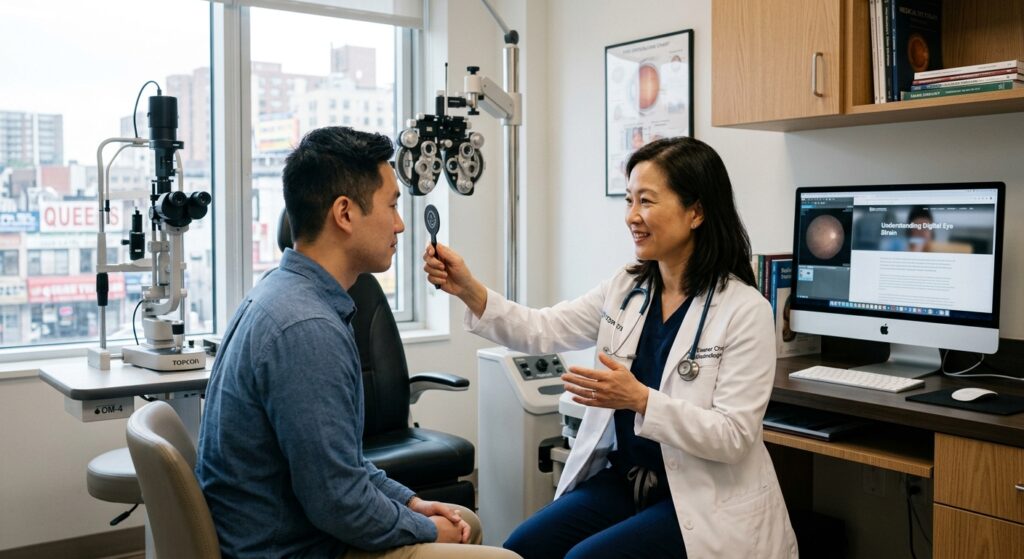
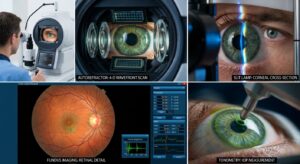
A comprehensive examination can evaluate your prescription, eye movements, focusing, ocular surface, optic nerve, retina, and other structures when indicated.
This distinction is important because some eye diseases have few or no noticeable early symptoms. The NEI identifies comprehensive dilated eye examinations as an important way to detect eye disease early.
Can an Eye Improve Exercise Remove Glasses?
No reliable eye improve exercise should be marketed as a way to permanently eliminate glasses.
Glasses correct how light focuses on the retina. Exercises do not generally correct the underlying optical shape responsible for refractive errors.
There may be selected circumstances where structured vision therapy or specific focusing exercises are appropriate, but those situations should be identified through an appropriate clinical assessment.
When Eye Fitness Should Not Be Your First Step
Do not rely on an eye workout when you have:
- Sudden vision loss
- New double vision
- Eye pain
- Flashes of light
- A sudden increase in floaters
- Significant redness
- New light sensitivity
- Persistent blurred vision
- Loss of part of your visual field
These symptoms can require prompt medical assessment rather than home exercises.
Eye Fitness for Long-Term Vision Preservation
The strongest eye fitness strategy is broader than exercise.
It includes controlling health conditions that can affect the eyes, eating a balanced diet, staying physically active, avoiding smoking, protecting the eyes from UV exposure, using appropriate safety eyewear, and keeping recommended eye examinations. These measures are consistent with current NEI healthy-vision guidance.
At LeeVision, the goal is to understand why a patient is experiencing visual discomfort rather than automatically recommending an eye workout. Dr. David H. Lee, MD, a board-certified ophthalmologist, can evaluate whether symptoms are related to refractive error, dry eye, digital eye strain, binocular vision, or another eye-health concern.
Frequently Asked Questions About Eye Fitness
What is eye fitness?
Eye fitness refers to healthy habits that support comfortable vision and protect the eyes over time. It includes regular screen breaks, adequate blinking, UV protection, healthy lifestyle choices, and appropriate eye examinations.
Can eye exercises improve eyesight?
Certain exercises may help specific focusing or eye-coordination problems, but they do not generally correct common refractive errors such as myopia, hyperopia, or astigmatism. The right approach depends on the underlying cause of the visual problem.
What is the best eye workout for tired eyes?
For ordinary screen-related fatigue, simple habits are often more useful than complicated movements. Looking away from the screen regularly, blinking fully, and changing your focusing distance can help reduce visual discomfort.
Can eye exercises remove the need for glasses?
Usually, no. Glasses correct the way light focuses inside the eye, while exercises generally cannot change the underlying optical structure responsible for a prescription.
Does the 20-20-20 rule improve vision?
The 20-20-20 rule is mainly intended to reduce discomfort associated with prolonged near work. It gives your eyes regular distance breaks, but it is not a treatment for refractive errors or eye disease.
What is an eye improve exercise?
An eye improve exercise usually refers to a technique designed to support focusing, convergence, or coordination between the eyes. These exercises are most useful when they address a specific problem identified during an eye examination.
Can these exercises help with computer eye strain?
They may help as part of a broader strategy. Regular breaks, frequent blinking, proper screen positioning, comfortable lighting, and treatment of underlying dry eye can all be important.
Can eye fitness prevent eye disease?
Healthy habits can support long-term eye health, but they cannot guarantee protection from conditions such as glaucoma, cataracts, or retinal disease. Regular examinations remain important, particularly as people get older.
Is an eye workout safe for everyone?
Not necessarily. Exercises should be appropriate for the person’s visual condition. Anyone experiencing persistent double vision, pain, sudden vision changes, or worsening symptoms should be evaluated rather than relying on home techniques.
Can exercises help dry eyes?
Some habits, especially conscious blinking and taking screen breaks, may reduce symptoms caused by prolonged digital use. However, ongoing dryness can have several causes and may require professional evaluation.
How often should I practice eye exercises?
There is no single schedule that applies to everyone. If a specific exercise program is recommended by an eye-care professional, the frequency should be based on the condition being treated and the individual’s response.
Can eye exercises improve children’s vision?
Children should not be given random online exercise programs to correct blurred vision. Difficulties with reading, focusing, eye coordination, or frequent headaches should first be assessed by an appropriate eye-care professional.
Does eye fitness help with aging eyes?
Healthy habits can support overall visual health, but they cannot stop normal age-related changes or eliminate conditions such as presbyopia. Regular eye care becomes increasingly important with age.
Can an eye workout fix blurry vision?
Blurred vision has many possible causes. An exercise may be relevant for a specific focusing or coordination problem, but persistent blur should be evaluated to determine whether glasses, contact lenses, medication, or another treatment is needed.
What is the safest way to improve visual comfort?
Start with simple measures: take regular screen breaks, blink frequently, maintain a comfortable viewing distance, protect your eyes outdoors, sleep adequately, and use the correct prescription.
When should I see an ophthalmologist?
Seek professional care when blurred vision persists or when you develop eye pain, sudden vision loss, new double vision, flashes, a sudden increase in floaters, significant redness, or other unusual changes.
Is eye fitness useful for people who work on computers?
Yes. People who spend many hours on computers can benefit from better visual habits. Regular breaks and blinking are particularly useful when prolonged screen use causes dryness or fatigue.
Can an eye improve exercise replace an eye examination?
No. An exercise cannot diagnose glaucoma, cataracts, retinal problems, dry eye disease, or changes in prescription. Professional evaluation is necessary when symptoms persist or change.
What should I do if my eyes feel weak after screen use?
“Eye weakness” is not a specific diagnosis. Tiredness may be related to digital eye strain, dry eye, an outdated prescription, focusing difficulty, or another issue. If symptoms continue, an eye examination can identify the cause.
Where can I get professional eye fitness guidance in Flushing, Queens?
Patients in Flushing, Queens, NYC can discuss persistent visual fatigue, focusing problems, dry eye symptoms, and general eye-health concerns with an ophthalmologist. At LeeVision, evaluation is focused on identifying the underlying cause rather than recommending exercises without a clear clinical reason.
Key Takeaway
The goal is not to perform as many exercises as possible. Good visual habits, appropriate correction, healthy lifestyle choices, and regular professional eye care provide a more reliable foundation for maintaining comfortable and healthy vision.
An exercise can be useful when it has a clear clinical purpose. It should never replace an examination when vision changes are persistent, sudden, painful, or otherwise concerning.
