


Non Surgical Eye Lift: What Works, What Does Not, and What to Expect
When people search for a non surgical eye lift, they are often looking for a way to make the area around the eyes look fresher without undergoing eyelid surgery. The concern may be loose-looking skin, under-eye hollows, fine lines, tired-looking eyes, or changes that become more noticeable with age.
But an important distinction is often missed: cosmetic rejuvenation of the eyelids is different from improving vision. A treatment that makes the skin around the eyes look smoother does not necessarily improve eyesight, and a treatment that improves near vision does not physically lift the eyelids.
For patients in Flushing, Queens, NYC, understanding that difference can make an eye consultation much more productive. At LeeVision, treatment planning should begin with identifying what is actually changing—eyelid position, skin quality, volume around the eyes, or vision.
What Does a Non Surgical Eye Lift Actually Mean?
A non surgical eye lift generally refers to treatments intended to improve the appearance of the upper or lower eyelid area without removing skin surgically.
Depending on the problem, non-surgical approaches may include carefully selected injectable treatments, skin-focused procedures, or other minimally invasive options. However, these treatments do not produce the same structural correction as eyelid surgery.
Eye Lift Without Surgery: What Can It Improve?
The phrase eye lift without surgery can mean different things to different patients. Some people are primarily concerned about:
- Fine lines around the eyes
- Mild skin laxity
- Under-eye hollows
- A tired or sunken appearance
- Loss of volume around the eyelids
- Early age-related changes in the brow and eyelid region
The appropriate treatment depends on the underlying anatomy. For example, adding volume may help a hollow area appear less sunken, but it cannot remove significant excess eyelid skin. Likewise, a cosmetic treatment should not be expected to correct true eyelid drooping caused by weakness or dysfunction of the muscles that elevate the eyelid.
This is why a proper examination matters before choosing an eye lift without surgery.
Non Surgical Eye Lift vs. Eyelid Surgery
A common misconception is that a non-surgical treatment can reproduce every result of blepharoplasty. It cannot.
Blepharoplasty is a surgical procedure that can remove or reposition excess skin and, when appropriate, address underlying fat or tissue. Non-surgical treatments are generally better suited to selected patients with milder cosmetic concerns.
| Concern | Non-surgical approach | Eyelid surgery |
|---|---|---|
| Mild fine lines | May improve appearance | Can also address surrounding tissue |
| Under-eye hollowing | Volume-based treatment may help selected patients | May involve fat repositioning |
| Excess eyelid skin | Limited ability to correct | Can directly remove excess skin |
| Significant eyelid drooping | Requires careful medical evaluation | May require surgical correction |
| Downtime | Usually less | Typically greater |
| Structural change | Limited | More substantial |
The right choice is not simply the treatment with the least downtime. It is the treatment that matches the actual cause of the concern.
How Aging Around the Eyes Can Affect Vision and Appearance
The eyes change in several ways as we age. The skin loses elasticity, facial volume can shift, and the eyelids may gradually change position. At the same time, the natural lens inside the eye becomes less flexible.
That last change causes presbyopia, the age-related loss of near focusing ability. The National Eye Institute explains that presbyopia commonly becomes noticeable after about age 45 and can cause difficulty reading, eye strain, and the need to hold reading material farther away.
This is where patients sometimes combine two separate concerns: looking younger around the eyes and seeing clearly at near distances.
Multifocal Lenses for Presbyopia: A Different Type of Vision Correction
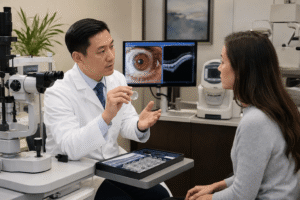
Multifocal lenses for presbyopia do not create a cosmetic eye lift. Instead, they are designed to help correct vision at different distances.
Multifocal contact lenses can provide correction for both near and distance vision, while multifocal eyeglass lenses can similarly help patients who need correction for more than one viewing distance.
For someone who spends much of the day switching between a phone, computer, paperwork, and distance viewing, this can be an important part of an overall vision plan.
Why Multifocal Lenses and Eye Rejuvenation Should Not Be Confused
A patient may say, “My eyes look tired, and I cannot read comfortably anymore.” Those are two different problems.
The appearance of tired eyes may relate to eyelid skin, volume, tear-film problems, or eyelid position. Difficulty reading may be related to presbyopia, refractive error, dry eye, or another eye condition.
A comprehensive eye examination helps separate these issues instead of treating everything as an aging-related cosmetic problem.
When Should You Consider an Eye Examination?
Before choosing a non surgical eye lift, an ophthalmic evaluation is especially important if you notice:
- One eyelid sitting lower than the other
- A sudden change in eyelid position
- Difficulty keeping an eye open
- New double vision
- Changes in peripheral vision
- Persistent eye irritation or dryness
- A noticeable decline in vision
These symptoms may indicate an underlying eye or eyelid condition rather than a purely cosmetic concern.
For patients considering treatment in Flushing, Queens, New York City, an evaluation with a board-certified ophthalmologist such as Dr. David H. Lee, MD can help determine whether the primary issue involves eyelid anatomy, facial volume, ocular surface health, refractive error, presbyopia, or another condition.
The goal should not simply be to make the eyes look different. The goal is to understand why the eyes look or feel different and choose an approach that protects both appearance and long-term eye health.
Which Non Surgical Eye Lift Options May Be Considered?
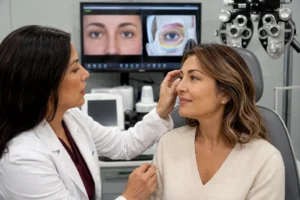
There is no single treatment that works for every person looking for a non surgical eye lift. The best option depends on whether the concern comes from skin laxity, fine lines, loss of facial volume, brow position, eyelid position, or the appearance of the under-eye area.
A careful examination is important because the same “tired eyes” appearance can have very different causes.
Injectable Treatments for Selected Patients
In carefully selected patients, injectable treatments may be used to soften certain facial lines or restore volume in areas that have become hollow with age.
For example, volume loss beneath the eyes can sometimes contribute to a sunken appearance. A properly selected treatment may improve the transition between the lower eyelid and cheek, creating a smoother appearance.
However, injections around the eyes require particular caution. The tissues are delicate, and the area contains important blood vessels and structures associated with vision. Treatment should therefore be performed only after an appropriate assessment by a qualified medical professional.
An injectable treatment also cannot remove substantial excess eyelid skin or correct every type of eyelid drooping.
Skin-Focused Treatments
Some patients are primarily concerned about fine lines, sun damage, or changes in skin texture around the eyes. Depending on the individual’s skin and medical history, certain energy-based or skin-rejuvenation treatments may be considered.
These approaches are intended to improve selected surface-level concerns rather than physically reposition the eyelid.
Results can also vary considerably. Age, skin quality, sun exposure, smoking history, genetics, and the degree of tissue laxity all influence how much improvement is realistically possible.
Who May Be a Candidate for an Eye Lift Without Surgery?
A person considering an eye lift without surgery may be a candidate when the concern is relatively mild and the desired improvement is primarily cosmetic.
A consultation should establish whether the patient has:
- Mild skin laxity
- Fine lines or wrinkles
- Under-eye volume loss
- Mild cosmetic asymmetry
- A desire for subtle rejuvenation
- Realistic expectations about the degree of improvement
The important word is mild.
If there is significant excess skin, substantial eyelid drooping, or functional obstruction of vision, a non-surgical treatment may not provide the correction the patient actually needs.
When a Non Surgical Treatment May Not Be Enough
Patients sometimes search for a non surgical eye lift because they want to avoid an operation completely. That preference is understandable, but avoiding surgery should not mean choosing a treatment that cannot address the underlying problem.
Excess Eyelid Skin
If excess upper-eyelid skin is the main issue, a treatment that improves skin texture may not remove enough tissue to create the desired change.
True Ptosis
Ptosis means that the upper eyelid sits lower than it should. It can occur for different reasons and may sometimes interfere with the upper field of vision.
Ptosis should be evaluated medically rather than automatically treated as an ordinary cosmetic aging concern.
Significant Structural Changes
When aging has produced substantial changes in eyelid skin, fat distribution, or supporting tissues, surgery may provide a more predictable structural correction.
This does not mean surgery is automatically the best choice. It means the treatment should match the anatomy.
Non Surgical Eye Lift: What Results Should You Expect?

One of the most important parts of an ophthalmology consultation is setting realistic expectations.
A non surgical eye lift may produce a refreshed or smoother appearance in an appropriate candidate, but it should not be described as equivalent to surgical eyelid rejuvenation.
Patients should understand that:
- Results may be subtle
- Improvement varies between individuals
- Some treatments require maintenance
- Aging continues after treatment
- Not every concern can be corrected without surgery
- Cosmetic improvement does not necessarily improve eyesight
The purpose of treatment should be meaningful improvement—not promising a completely different appearance.
What About Dry Eyes and Eye Comfort?
Another issue that deserves attention is the ocular surface—the thin tear film covering the front of the eye.
Dry eye disease is common, and symptoms can include burning, fluctuating vision, irritation, redness, or a gritty sensation. Patients who spend many hours looking at computers and phones may also notice worsening discomfort because prolonged screen use can reduce blinking.
This can be particularly relevant for patients in Flushing, Queens, NYC, where busy work schedules, commuting, indoor heating or air conditioning, and seasonal allergies may contribute to eye discomfort.
If the eyes feel dry or irritated, treating the ocular surface may sometimes make the eyes appear and feel healthier without any cosmetic procedure.
A patient should not assume that every tired-looking eye requires an eye lift without surgery.
Can Multifocal Lenses Help With an Aging Appearance?
No. Multifocal lenses for presbyopia are a vision-correction option, not an eyelid-rejuvenation procedure.
This distinction is important because patients frequently notice several age-related changes at the same time. They may develop reading difficulty from presbyopia while also noticing wrinkles, eyelid laxity, or under-eye hollowing.
Multifocal contact lenses may help selected patients see at multiple distances, but they do not tighten eyelid skin or reposition the eyelids.
If multifocal lenses are being considered, the prescription, eye health, tear film, corneal shape, lifestyle, and visual expectations all need to be considered.
Questions to Ask Before Choosing a Non Surgical Eye Lift
Before proceeding with treatment, patients can make the consultation more useful by asking:
- What is actually causing my eyelid or under-eye concern?
- Is this cosmetic, functional, or both?
- Would a non-surgical treatment realistically help?
- What improvement can I reasonably expect?
- Are there risks specific to treatment around my eyes?
- Could dry eye affect my treatment experience?
- Would eyelid surgery provide a more appropriate correction?
- Do I need a comprehensive eye examination first?
These questions help shift the conversation away from simply asking, “Which treatment is best?” and toward the more important question: “Which treatment is appropriate for my eyes?”
Choosing an Ophthalmologist for Eye Rejuvenation
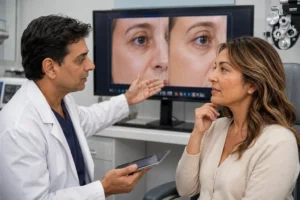
The tissues surrounding the eyes are closely connected to normal vision, eyelid function, tear drainage, and ocular surface health. For this reason, evaluation by an ophthalmologist can be valuable when cosmetic concerns overlap with eye or eyelid function.
At LeeVision, patients in Flushing and throughout Queens can have their eye health and visual needs evaluated alongside concerns involving the eyelids and surrounding eye area. Dr. David H. Lee, MD, a board-certified ophthalmologist, can assess the underlying issue and discuss appropriate treatment options based on the patient’s anatomy, eye health, and goals.
The most appropriate plan may involve observation, treatment of an underlying eye condition, a non-surgical approach, or referral for surgical correction when necessary.
The objective is not to promise a “perfect” eye lift. It is to make an informed decision that balances appearance, function, safety, and long-term eye health.
Understanding the Limits of a Non Surgical Eye Lift
The biggest advantage of a non surgical eye lift is that selected patients may achieve a refreshed appearance without undergoing eyelid surgery. However, the trade-off is that non-surgical treatments generally cannot create the same structural changes as surgery.
A patient with mild cosmetic concerns may be satisfied with a subtle improvement. Someone with significant excess skin or true eyelid drooping may need a different approach.
This distinction is especially important when expectations are high. The goal should be improvement that looks natural and remains consistent with healthy eyelid and eye function.
Appearance Is Not the Same as Vision
An important part of an eye consultation is separating cosmetic concerns from visual concerns.
Wrinkles, loose skin, under-eye hollows, and eyelid position affect appearance. Presbyopia, refractive errors, cataracts, dry eye disease, and other eye conditions can affect vision.
For example, multifocal lenses for presbyopia may help an appropriately selected patient with near and distance vision, but they will not tighten eyelid skin or create an eye lift without surgery.
Understanding this difference prevents patients from expecting one treatment to solve several unrelated problems.
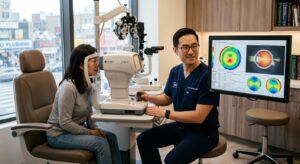
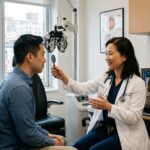
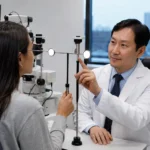
How an Ophthalmologist Approaches Eye Rejuvenation
A thoughtful evaluation starts with the patient’s goals and then examines the eyes rather than beginning with a specific cosmetic procedure.
An ophthalmologist may consider:
- Eyelid position and symmetry
- Amount of excess eyelid skin
- Brow position
- Under-eye contour
- Facial volume changes
- Tear-film and ocular surface health
- Vision and refractive status
- Signs of ptosis
- Overall eye health
This approach is particularly useful for older adults who are experiencing several changes simultaneously.
A patient may think the eyes simply look “tired,” while the examination reveals a combination of dry eye, presbyopia, eyelid changes, or another condition. Addressing the correct cause is more useful than treating the appearance alone.
When to Seek Medical Evaluation Rather Than Cosmetic Treatment
Not every change around the eye should be considered an aging or cosmetic issue.
Medical evaluation becomes especially important if an eyelid suddenly droops, vision changes unexpectedly, double vision develops, the eye becomes persistently painful or red, or there is a noticeable difference between the two eyes.
These symptoms deserve proper ophthalmic assessment before any cosmetic procedure is considered.
For patients in Flushing, Queens, New York City, an eye examination can help determine whether the concern is primarily cosmetic or whether an underlying eye or eyelid condition needs attention.
Frequently Asked Questions About Non Surgical Eye Lift
What is a non surgical eye lift?
A non surgical eye lift is a general term for cosmetic approaches intended to improve the appearance of the eyelids or surrounding eye area without traditional eyelid surgery. Depending on the concern, treatment may involve skin-focused procedures or carefully selected injectable treatments.
It does not provide the same structural correction as blepharoplasty.
Does an eye lift without surgery really work?
An eye lift without surgery can provide noticeable improvement for some patients with mild cosmetic concerns. The amount of improvement depends on the cause of the concern, skin quality, anatomy, and treatment selected.
It is important to have realistic expectations because non-surgical treatment cannot remove substantial excess skin or correct every type of eyelid drooping.
What is the best non surgical eye lift?
There is no single best non surgical eye lift for everyone. The appropriate treatment depends on whether the main concern is fine lines, skin texture, volume loss, eyelid position, or another issue.
A qualified medical evaluation should come before choosing a treatment.
Can fillers create an eye lift without surgery?
Fillers may improve selected areas of volume loss around the eyes and can sometimes create a smoother or more refreshed appearance. However, they do not actually remove excess eyelid skin or physically lift a drooping eyelid.
Because the area around the eyes contains delicate structures and important blood vessels, injectable treatment requires careful patient selection and appropriate medical expertise.
How long does a non surgical eye lift last?
The duration depends entirely on the treatment used and the individual patient. Some non-surgical approaches provide temporary improvement and may require maintenance, while results from skin-focused treatments can vary according to the patient’s skin and lifestyle.
Patients should ask about expected longevity before treatment rather than assuming that a cosmetic result will be permanent.
Is a non surgical eye lift safer than eyelid surgery?
Non-surgical treatment may involve less downtime than surgery, but “non-surgical” does not automatically mean risk-free.
Treatments around the eyes can have specific complications, and the risks depend on the procedure. The safest choice is the one that is appropriate for the patient’s anatomy and performed by a properly qualified medical professional.
Can a non surgical eye lift fix droopy eyelids?
It depends on why the eyelid is drooping. Mild cosmetic changes may sometimes be improved without surgery, but true ptosis or significant excess eyelid skin requires medical evaluation.
If drooping affects the visual field or develops suddenly, it should not be treated as a purely cosmetic concern.
Can multifocal lenses for presbyopia improve the appearance of my eyes?
No. Multifocal lenses for presbyopia are designed to improve vision at different distances; they do not tighten eyelid skin or reposition the eyelids.
They may be useful for patients who have difficulty reading or focusing on near objects because of presbyopia, but this is separate from cosmetic eye rejuvenation.
Are multifocal contact lenses good for presbyopia?
Multifocal contact lenses can be an option for appropriately selected people with presbyopia. The prescription, corneal health, tear film, lifestyle, and visual expectations all matter when determining whether they are suitable.
An eye examination and contact lens evaluation are important before choosing this type of correction.
Can dry eyes make my eyes look tired?
Yes. Dry eye symptoms can include irritation, redness, fluctuating vision, and a tired or uncomfortable feeling around the eyes.
Patients who spend long periods on computers or phones may notice symptoms more often because concentrated screen use can reduce blinking. Treating an underlying ocular-surface problem may therefore be an important part of improving how the eyes feel.
Is an eye lift without surgery better than blepharoplasty?
Neither option is automatically better. They address different degrees and types of problems.
An eye lift without surgery may suit someone seeking a subtle improvement in selected cosmetic concerns, while blepharoplasty may be more appropriate when significant excess skin or structural changes need correction.
The decision should be based on anatomy, goals, medical findings, recovery preferences, and realistic expectations.
When should I see an ophthalmologist for eyelid changes?
An ophthalmologist should evaluate eyelid changes when they affect vision, develop suddenly, are significantly asymmetric, are associated with double vision or pain, or do not seem purely cosmetic.
Even when the concern is cosmetic, an eye examination can help identify conditions that may influence treatment choices and safety.
Final Takeaway
A non surgical eye lift can be an appropriate option for selected patients who want subtle improvement around the eyes without traditional eyelid surgery. But the right treatment depends on the actual cause of the concern.
An eye lift without surgery cannot reproduce every result of blepharoplasty, and no cosmetic procedure should be expected to stop the natural aging process.
At the same time, age-related vision changes such as presbyopia should be addressed separately. Multifocal lenses for presbyopia may help selected patients manage difficulty seeing at different distances, but they are a vision-correction solution rather than an eyelid-rejuvenation treatment.
For patients considering treatment in Flushing, Queens, NYC, the most useful first step is a comprehensive evaluation. Understanding the difference between cosmetic aging, eyelid function, ocular-surface health, and vision correction allows patients to make decisions based on evidence, safety, and realistic expectations.