






Seeing two images instead of one can be unsettling. Some people notice double vision only while reading or using a phone, while others experience it when looking across a room, driving, or moving their eyes in certain directions.
This often leads to a simple question: Can eye exercises for double vision actually help?
The answer is sometimes—but it depends heavily on why the double vision is happening. Eye exercises are not a universal treatment for diplopia, and trying exercises without knowing the underlying cause can delay an important eye or medical evaluation.
For patients in Flushing, Queens, NYC, where long periods of computer, smartphone, and close-up work are common, it is particularly important to distinguish ordinary visual fatigue from a genuine binocular vision problem.
What Is Double Vision?
Double vision, medically called diplopia, occurs when a person perceives two images of one object. The images may appear side by side, one above the other, or at an angle.
One of the first questions an ophthalmologist needs to answer is whether the double vision is monocular or binocular.
Monocular vs. Binocular Double Vision
Monocular diplopia remains when one eye is covered. It can be associated with problems involving the cornea, tear film, lens, or refractive error.
Binocular diplopia disappears when either eye is covered. This usually means that the two eyes are not working together in proper alignment.
That distinction matters because exercises designed to improve coordination between the eyes may have a role in selected binocular conditions, but they are not appropriate treatment for every cause of double vision.
Can Eye Exercises Help Double Vision?
In selected patients, yes.
One example is convergence insufficiency, a condition in which the eyes have difficulty turning inward and maintaining comfortable single vision during near activities. People with convergence insufficiency may experience double vision, blurry vision, headaches, or tired eyes while reading or using a computer.
For this condition, an eye doctor may recommend convergence exercises or vision therapy. These exercises are designed to train the visual system to coordinate the two eyes more effectively.
However, this does not mean that every person with double vision should perform random eye exercises.
Double vision can have many causes, including eye misalignment, refractive problems, thyroid-related eye disease, nerve or muscle problems, and other neurological or ocular conditions. The appropriate treatment therefore depends on the diagnosis.
Eye Exercises for Double Vision: Which Ones May Be Used?
When an eye examination confirms a problem such as convergence insufficiency, an ophthalmologist or qualified vision professional may recommend specific exercises.
Pencil Push-Ups
Pencil push-ups are a traditional convergence exercise.
A person focuses on a small target and gradually brings it closer while attempting to maintain comfortable single vision. The purpose is to encourage the eyes to converge as the target approaches.
Although this exercise is commonly discussed online, it should not automatically be assumed to be appropriate for every patient with diplopia. Proper diagnosis comes first. Current ophthalmology references recognize convergence exercises as one treatment approach for convergence insufficiency.
Near-Far Focusing
Some patients are given exercises that involve shifting visual attention between near and distant targets.
These activities can challenge the focusing and binocular coordination systems. However, they are better viewed as part of an individualized treatment plan rather than a guaranteed method for improving eyesight.
Structured Vision Therapy

For certain binocular vision disorders, treatment may involve supervised exercises performed in an office, home-based exercises, computer-based vergence activities, or a combination.
The goal is not simply to make the eye muscles “stronger.” Instead, therapy may be designed to improve vergence, which refers to the coordinated inward or outward movement of the eyes needed to maintain single binocular vision.
Are Eye Exercises to Improve Vision the Same as Exercises for Double Vision?
No.
This is an important distinction because the phrase eye exercises to improve vision can mean very different things online.
Exercises may help certain aspects of binocular coordination or visual function, but they generally cannot reverse conditions such as cataracts, correct the shape of the cornea in the way glasses or refractive surgery can, or repair retinal disease.
Similarly, eye exercises to improve eyesight should not be presented as a replacement for an appropriate prescription, eye examination, or treatment when an eye disease is present.
For example, blurry vision caused by myopia, hyperopia, astigmatism, or presbyopia is related to how light is focused within the eye. These refractive errors are generally managed with glasses, contact lenses, or other appropriate treatments rather than relying on exercises alone.
When Should Double Vision Be Evaluated?
A new or unexplained change in vision deserves attention.
You should arrange an eye evaluation if double vision:
- Appears suddenly or repeatedly
- Continues to occur without an obvious explanation
- Is affecting reading, computer work, walking, or driving
- Becomes worse when looking in a particular direction
- Occurs with headaches, eye pain, drooping eyelids, or other visual changes
Sudden-onset double vision can occasionally signal a problem that requires prompt medical assessment, so it should not simply be treated with home exercises.
A comprehensive evaluation can help determine whether the problem involves the eye surface, prescription, eye alignment, eye movements, or another part of the visual system.
What an Eye Doctor Looks For

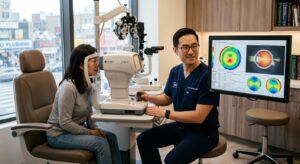
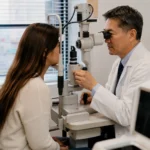
During an evaluation, the ophthalmologist may assess visual acuity, eye movements, alignment, focusing ability, and binocular function. Cover testing and other measurements can help identify whether the eyes are properly aligned and how much they deviate when looking at different distances or directions.
This is especially important because someone can have otherwise good visual acuity and still have a binocular vision disorder.
The Most Important Takeaway
Eye exercises for double vision can be useful in specific conditions, particularly convergence insufficiency, but they are not a general cure for diplopia.
The right first step is identifying the cause. Once the diagnosis is clear, an ophthalmologist can determine whether exercises, glasses, prism correction, treatment of an underlying eye condition, or another approach makes sense.
How Eye Exercises May Help Double Vision
When both eyes are working together normally, the brain receives two slightly different images and combines them into one clear perception. This process is called binocular vision.
If the eyes have difficulty maintaining proper alignment, the brain may receive images that do not line up comfortably. The result can be double vision, eye strain, headaches, or difficulty concentrating during near work.
Convergence Exercises
Convergence is the ability of both eyes to turn inward when looking at something close.
For people with convergence insufficiency, exercises may be prescribed to improve the ability to maintain comfortable near alignment.
A commonly discussed exercise is bringing a small target gradually closer while trying to keep it single. If the target becomes double, the patient may be instructed to move it back until single vision returns.
The important point is that the exercise should be performed according to an appropriate treatment plan. More exercise is not necessarily better, and repeatedly forcing the eyes to maintain an uncomfortable image can make symptoms worse.
Near and Far Focusing Activities
Some vision-training programs use alternating near and distant targets.
For example, a patient may focus on a nearby object and then shift attention to a distant object. This can challenge the focusing system and the coordination between focusing and eye alignment.
These activities may be useful for selected visual problems, but they should not be advertised as a universal way to improve eyesight.
Can Eye Exercises Improve Eyesight?
This depends on what someone means by “improve eyesight.”
If the problem is related to a specific binocular vision disorder, exercises may improve certain aspects of visual coordination and reduce symptoms.
But eye exercises to improve eyesight cannot correct every cause of blurry vision.
What Exercises Cannot Usually Fix
Exercises should not be expected to:
- Remove a cataract
- Permanently reshape the cornea
- Reverse retinal disease
- Replace glasses when a significant refractive error is present
- Treat every form of eye misalignment
- Correct a neurological cause of double vision
- Eliminate age-related changes such as presbyopia
This distinction is important because online claims sometimes make eye exercises sound capable of correcting almost any vision problem.
An ophthalmologist first determines whether the limitation is caused by focusing, eye alignment, the eye’s optical structures, or another medical condition.
Eye Exercises to Improve Vision: Who May Benefit?
People sometimes search for eye exercises to improve vision because their eyes feel tired after working at a computer or looking at a phone for several hours.
Digital eye strain can produce symptoms such as:
- Tired or aching eyes
- Temporary blurred vision
- Difficulty refocusing between distances
- Headaches
- Dryness or irritation
- Difficulty maintaining comfortable near vision
In a screen-heavy environment such as New York City, these complaints are common among office workers, students, commuters, and people who spend much of the day on smartphones.
However, digital eye strain does not automatically mean that the eyes have become weak.
The 20-20-20 Rule
For prolonged screen use, taking regular visual breaks can be helpful. A commonly recommended approach is the 20-20-20 rule: approximately every 20 minutes, look at something about 20 feet away for around 20 seconds.
This is different from treatment for pathological double vision.
The purpose is to reduce prolonged near-focus demand and give the visual system an opportunity to relax.
What If Exercises Make Double Vision Worse?
Stop and seek professional guidance if an exercise consistently causes significant discomfort, persistent double vision, dizziness, nausea, headaches, or worsening visual symptoms.
A mild awareness of the eyes working during a prescribed exercise may occur, but patients should not assume that increasing discomfort means the exercise is working better.
This is one reason individualized treatment matters.
Double Vision After Eye Surgery or an Injury
Double vision following eye surgery, head trauma, or an eye injury deserves professional assessment rather than self-treatment.
The cause could involve changes in alignment, the eye muscles, nerves, the ocular surface, or other structures.
Likewise, double vision associated with a drooping eyelid, severe headache, weakness, facial symptoms, unequal pupils, or other sudden neurological symptoms requires prompt medical attention.
How Long Does It Take for Eye Exercises to Work?
There is no single timeline.
Response depends on the underlying condition, the severity of the problem, how consistently treatment is performed, and whether exercises are actually appropriate for the diagnosis.
Some patients may notice improvement in symptoms relatively early, while others require a longer course of structured therapy.
The realistic goal is not necessarily perfect vision without glasses or treatment. A more appropriate goal may be more comfortable and stable binocular vision.
Exercises vs. Other Treatments for Double Vision

| Approach | When It May Be Considered | Main Limitation |
|---|---|---|
| Convergence exercises | Selected convergence problems | Not appropriate for every cause of diplopia |
| Prescription glasses | Refractive errors or certain alignment problems | May not address the underlying cause |
| Prism correction | Certain forms of binocular misalignment | Does not correct every underlying condition |
| Treating an underlying disease | When another medical condition causes diplopia | Depends entirely on the diagnosis |
| Surgery | Selected persistent eye-muscle alignment problems | Requires careful evaluation and carries surgical risks |
An experienced ophthalmologist considers the cause, symptoms, examination findings, lifestyle demands, and long-term visual needs before recommending treatment.
A Common Mistake: Assuming All Double Vision Is the Same

Two people can both say, “I see double,” while having completely different eye conditions.
One person may have symptoms only during prolonged reading. Another may experience double vision when looking far away. A third may have symptoms in one eye because of an optical problem.
That is why a search for eye exercises for double vision should be the beginning of education—not the end of the diagnostic process.
What Patients Should Ask During an Eye Examination
If you experience double vision, useful questions include:
- Is my double vision monocular or binocular?
- What is causing the eyes to produce two images?
- Do I have a problem with convergence or eye alignment?
- Would exercises actually benefit my condition?
- Could glasses or prism correction help?
- Is there an underlying eye or medical condition that needs treatment?
- What symptoms should prompt an urgent evaluation?
These questions can make the consultation more productive and help ensure that treatment is based on the actual cause rather than an internet exercise routine.
What About Eye Exercises to Improve Eyesight Long Term?
Maintaining healthy vision involves much more than exercises.
Regular comprehensive eye examinations, appropriate treatment of refractive errors, managing conditions such as dry eye, protecting the eyes from injury, controlling systemic health risks, and seeking evaluation when vision changes are all part of long-term eye care.
For patients in Flushing, Queens, NYC, particularly those balancing intensive screen use with work, commuting, and everyday visual demands, understanding the difference between temporary eye fatigue and a genuine vision disorder is valuable.
The key message is simple: exercises can be useful when they target the right problem. They should not be used to guess at the diagnosis.
Eye Exercises for Double Vision: FAQs, Treatment Limits, and Key Takeaways
By this point, the most important point should be clear: eye exercises for double vision are not a one-size-fits-all solution. They can be useful for selected binocular vision problems, but double vision has many possible causes, and the correct treatment depends on identifying that cause first.
For someone searching for eye exercises to improve vision or eye exercises to improve eyesight, it is equally important to understand what exercises can and cannot realistically accomplish.
Frequently Asked Questions About Eye Exercises for Double Vision
Can eye exercises permanently fix double vision?
Not necessarily. Eye exercises for double vision may improve symptoms when the underlying problem is appropriate for vision therapy, such as certain cases of convergence insufficiency.
However, exercises cannot correct every cause of diplopia. If double vision results from a cataract, corneal problem, significant refractive error, nerve disorder, eye-muscle problem, or another medical condition, the treatment needs to address that underlying cause.
What are the best eye exercises for double vision?
There is no single “best” exercise for everyone.
Depending on the diagnosis, eye exercises for double vision may include convergence activities, near-far focusing tasks, or structured binocular vision exercises.
The safest approach is to have an ophthalmologist determine whether an exercise program is appropriate before starting one.
Can eye exercises improve eyesight naturally?
Eye exercises to improve eyesight are frequently promoted online, but their benefits are often overstated.
Exercises may improve certain aspects of binocular coordination in appropriate patients. They generally cannot eliminate refractive errors, remove cataracts, repair retinal disease, or reverse other structural problems affecting vision.
Do eye exercises improve vision permanently?
Eye exercises to improve vision may provide lasting functional benefits in some diagnosed binocular vision conditions, but there is no universal guarantee of permanent improvement.
The outcome depends on the underlying condition, treatment approach, consistency, and individual response.
Can eye exercises help blurry vision?
It depends on why the vision is blurry.
If blurry vision is related to focusing or binocular coordination, selected exercises may have a role. But blurry vision can also result from dry eye, refractive error, cataracts, retinal disease, corneal conditions, or other causes.
That is why eye exercises to improve vision should not replace an eye examination when blurry vision is persistent.
Can eye exercises help double vision from tired eyes?
Sometimes symptoms that feel like double vision are actually temporary visual fatigue or intermittent difficulty maintaining comfortable focus.
However, true double vision should not automatically be attributed to tired eyes. If the symptom is recurring or persistent, an ophthalmologic evaluation can help determine whether there is an actual binocular alignment problem.
How often should I do eye exercises for double vision?
There is no universal schedule.
If eye exercises for double vision are prescribed as part of a treatment plan, the frequency should follow the recommendations of the eye-care professional managing the condition.
Doing exercises excessively does not necessarily produce faster improvement.
Can screen time cause double vision?
Long periods of screen use can contribute to digital eye strain, dryness, temporary blur, and difficulty maintaining comfortable near focus.
But persistent or genuine double vision should not automatically be blamed on screens.
For people in Flushing, Queens, NYC, where computer and smartphone use can be part of daily work and commuting routines, regular visual breaks can help reduce screen-related discomfort. They do not, however, substitute for evaluation of persistent diplopia.
Does the 20-20-20 rule cure double vision?
No.
The 20-20-20 approach can be a useful habit for reducing prolonged near-focus strain during screen use. It is not a treatment for every form of double vision.
If you continue seeing two images despite taking breaks, an eye examination is more appropriate than simply increasing breaks or performing more eye exercises for double vision.
Can eye exercises replace glasses?
Usually not.
Glasses correct refractive errors by changing how light enters the eye and is focused onto the retina. Eye exercises to improve eyesight do not generally replace a needed prescription.
Some patients may require glasses, contact lenses, prism correction, or another treatment depending on the cause of their visual symptoms.
Can eye exercises help convergence insufficiency?
Yes. This is one situation in which eye exercises for double vision may have an established role.
Convergence insufficiency affects the ability of the eyes to work together comfortably at near distances. Treatment may include specific convergence exercises or structured vision therapy.
An eye-care professional should confirm the diagnosis before treatment begins.
Can children and adults use the same eye exercises?
Not necessarily.
The type of binocular vision problem, age, visual demands, ability to follow instructions, and overall eye health all influence treatment planning.
An exercise program for a child should not simply be copied from an adult’s routine found online.
When should I see an ophthalmologist for double vision?
You should arrange an evaluation when double vision is persistent, recurrent, unexplained, or interfering with normal activities.
Sudden-onset double vision deserves particular attention, especially when it occurs with symptoms such as severe headache, weakness, drooping eyelid, facial changes, difficulty speaking, dizziness, or other neurological symptoms. In those circumstances, prompt medical assessment is important.
Is double vision always caused by an eye problem?
No.
Double vision can arise from problems involving the eyes, eye muscles, nerves controlling eye movement, the brain, or other medical conditions.
This is another reason eye exercises for double vision should not be used as a substitute for diagnosis.
What Is the Safest Approach?
If you are experiencing double vision, the most useful sequence is straightforward:
- Determine whether the double vision is monocular or binocular.
- Identify the underlying cause.
- Assess eye alignment, eye movements, focusing, and overall eye health.
- Decide whether exercises are appropriate.
- Use glasses, prism, medication, surgery, or other treatment when indicated.
- Monitor symptoms and follow up when recommended.
This approach is more reliable than choosing eye exercises to improve vision simply because they are popular online.
Eye Exercises for Double Vision: What Patients Should Remember
The internet contains many claims about eye exercises to improve eyesight, but good eye care requires realistic expectations.
Eye exercises for double vision can be valuable when they are directed at the right diagnosis. They may help selected patients improve binocular coordination and visual comfort, particularly when convergence problems are involved.
They are not a general cure for double vision, and they should not delay an eye examination when symptoms are new, persistent, or unexplained.
For patients seeking an ophthalmologic evaluation in Flushing, Queens, New York City, LeeVision provides information about comprehensive eye care, diagnostic evaluation, and vision-related conditions through its practice resources at.
The goal of a proper evaluation is not simply to find an exercise. It is to understand why the double vision is happening and choose the safest evidence-based approach for that individual patient.