





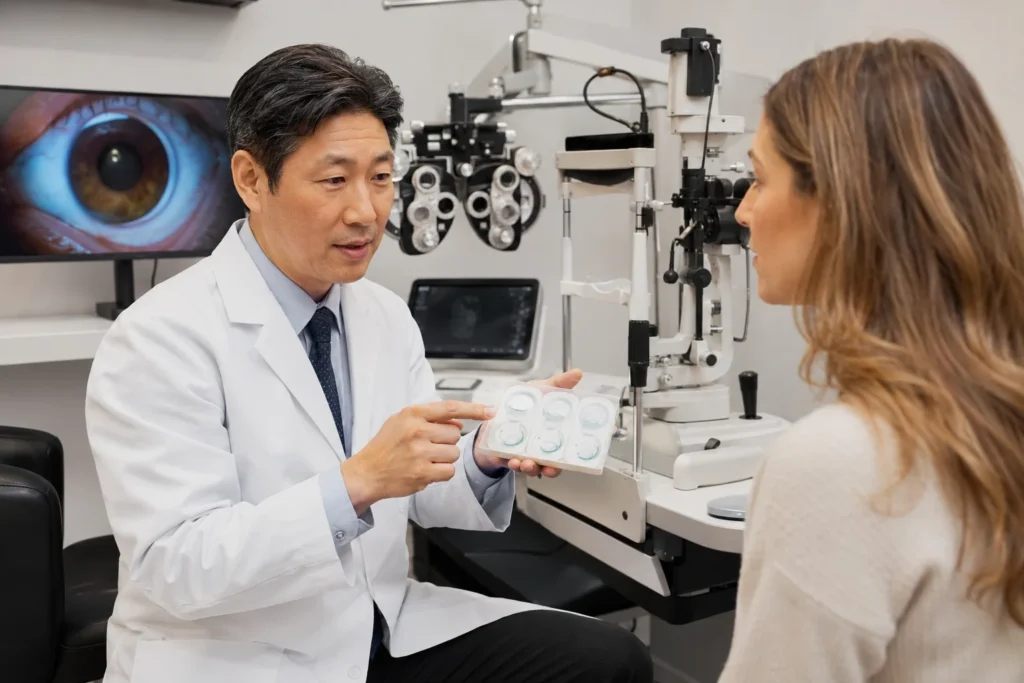
Best Multifocal Contacts: A Practical Guide to Clear Vision at Every Distance
If you’ve recently found yourself holding your phone farther away to read text messages or switching between reading glasses and distance glasses throughout the day, you’re not alone. These are common signs of age-related near vision changes, often beginning in your 40s. Many patients visiting LeeVision in Flushing, Queens, New York City ask the same question.
“Are the best multifocal contacts a real replacement for reading glasses?”
The answer depends on your eyes, lifestyle, and visual needs. Modern multifocal contact lenses have improved significantly over the past decade. Today’s designs can provide clear vision for many daily activities—including reading, computer work, driving, and distance viewing—without constantly changing glasses.
This guide explains what are multifocal contact lenses, how do multifocal contact lenses work, who may benefit from them, their advantages and limitations, and what to expect during a professional contact lens fitting.
Understanding Multifocal Contact Lense
Multifocal contact lenses are specially designed lenses that help you see at multiple distances using a single lens.
Unlike standard contact lenses that correct only one distance, multifocal lenses combine different focusing powers into one lens so your eyes can transition more naturally between:
- Distance vision
- Intermediate vision (computer screens)
- Near vision (books, smartphones, menus)
This makes them one of the most popular options for adults experiencing presbyopia, the natural loss of near focusing ability that occurs with age.
Many patients searching for the best multifocal contacts are actually looking for greater convenience—wanting to reduce dependence on reading glasses while maintaining comfortable vision throughout the day.
Why Do People Need Multifocal Contacts?
One of the most common questions during eye exams is:
“My distance vision is still good, so why can’t I read small print anymore?”
The reason is usually presbyopia.
Inside the eye is a natural lens that changes shape to focus on nearby objects. As we age, this lens gradually becomes less flexible. Even perfectly healthy eyes eventually lose some of their ability to focus up close.
This change is normal and happens to nearly everyone.
Common symptoms include:
- Holding reading material farther away
- Eye fatigue after reading
- Blurry vision on smartphones
- Difficulty seeing restaurant menus
- Frequent switching between glasses
- Headaches after prolonged close work
For many adults in Flushing, Queens, NYC, these symptoms become more noticeable because of long hours spent using computers, tablets, and mobile devices.
What Are Multifocal Contact Lenses?
Patients often ask:
“What are multifocal contact lenses exactly?”
Think of them as multiple prescription zones built into one contact lens.
Instead of having only one prescription strength, multifocal lenses contain carefully designed optical areas that allow your brain to choose the clearest image depending on what you’re looking at.
Rather than consciously switching between prescriptions, your visual system naturally adapts to different distances.
Modern multifocal lenses are available in:
- Daily disposable lenses
- Monthly replacement lenses
- Soft contact lenses
- Certain rigid gas permeable (RGP) lenses
- Some specialty custom lenses
Your eye doctor determines which option is most appropriate based on your prescription, tear film quality, corneal shape, and lifestyle.
How Do Multifocal Contact Lenses Work?
Understanding how do multifocal contact lenses work helps set realistic expectations.
Unlike bifocal glasses that have a visible dividing line, multifocal contacts use sophisticated optical designs.
Different areas of the lens focus light for:
- Far distance
- Intermediate tasks
- Near reading
As your eyes move naturally throughout the day, your brain learns to prioritize the sharpest image for the task you’re performing.
This process is called neuroadaptation.
Most people adjust gradually over several days or weeks.
During this period, you may notice:
- Slight halos around lights
- Mild blur in certain lighting
- Small differences compared with wearing glasses
These adjustments are usually temporary as your brain becomes accustomed to processing multiple focal zones simultaneously.
Types of Multifocal Contact Lens Designs
Not all multifocal lenses work the same way. Different designs suit different patients.
| Lens Design | Best For | Advantages |
|---|---|---|
| Center-Near Design | Reading-focused patients | Excellent near vision |
| Center-Distance Design | Active lifestyles | Better distance clarity |
| Aspheric Multifocal | Most everyday users | Smooth transition between distances |
| Segmented Multifocal | Selected specialty fittings | Stable vision for certain prescriptions |
A comprehensive eye examination helps determine which design is most suitable.
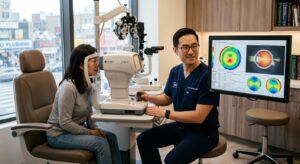
Advanced diagnostic measurements—including corneal mapping, tear film evaluation, and precise refraction—can improve fitting accuracy and overall comfort.
Who Is a Good Candidate for the Best Multifocal Contacts?
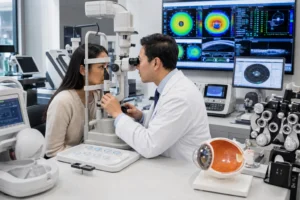
Not everyone requires multifocal contact lenses, but many adults are excellent candidates.
You may benefit if you:
- Are over age 40
- Have presbyopia
- Want fewer reading glasses
- Already wear contact lenses
- Have healthy eyes
- Spend time using computers
- Drive regularly
- Want convenient vision correction for daily activities
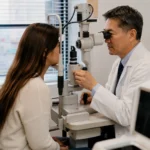
During a consultation, a board-certified ophthalmologist or experienced eye care professional evaluates factors beyond your prescription alone.
These include:
- Eye health
- Dry eye symptoms
- Pupil size
- Corneal shape
- Tear quality
- Visual goals
- Occupational demands
- Night driving needs
At LeeVision in Flushing, Queens, New York City, individualized contact lens evaluations focus on finding the safest and most appropriate option based on each patient’s unique vision needs rather than using a one-size-fits-all approach.
Are Multifocal Contact Lenses Better Than Reading Glasses?
This is one of the most common consultation questions.
The answer depends on your lifestyle.
| Multifocal Contacts | Reading Glasses |
|---|---|
| Convenient for active lifestyles | Simple solution for occasional reading |
| Correct multiple distances | Only help near vision |
| Hands-free vision | Must be carried everywhere |
| Better for sports and travel | Easy to lose or forget |
| Require professional fitting | Available over the counter for some people |
Neither option is universally “better.” The right choice depends on your daily activities, eye health, and personal preferences.
Many patients even use both—multifocal contacts during the day and reading glasses for extended close work.
Benefits of Choosing the Best Multifocal Contacts
The best multifocal contacts can make everyday life more convenient by reducing the need to constantly switch between different pairs of glasses. While no contact lens can guarantee perfect vision in every situation, many patients experience excellent functional vision for work, hobbies, and daily activities.
Some of the most appreciated benefits include:
- Clear vision for near, intermediate, and distance tasks
- Less dependence on reading glasses
- Natural-looking appearance without bifocals
- Comfortable option for active lifestyles
- Better convenience while traveling
- Useful for computer work and digital devices
- Available in daily disposable and monthly replacement options
- Modern lens materials that allow good oxygen flow to the eyes
Many office workers in Flushing, Queens, New York City appreciate multifocal lenses because they frequently alternate between computer screens, paperwork, and conversations throughout the day.
Are There Any Limitations?
Patients often expect multifocal contact lenses to provide perfect vision under every condition. In reality, there are some limitations that are important to understand before starting.
Possible challenges include:
- A short adaptation period
- Mild halos around lights at night
- Slightly reduced sharpness in dim lighting
- Reading very small print may still require reading glasses
- Trial lenses may be needed before finding the best fit
Setting realistic expectations is one of the most important parts of a successful contact lens fitting.
Multifocal Contacts vs Monovision
Some patients are offered monovision instead of multifocal lenses.
In monovision, one eye is corrected primarily for distance vision while the other is corrected for near vision. Your brain learns to rely on each eye for different tasks.
| Multifocal Contact Lenses | Monovision |
|---|---|
| Both eyes help at multiple distances | One eye focuses on distance, the other on near |
| More natural binocular vision | May slightly reduce depth perception |
| Better for many everyday activities | Works well for selected patients |
| Often preferred for computer users | Sometimes easier to adapt to |
The right option depends on your prescription, eye health, occupation, and personal preferences.
Dry Eyes and Multifocal Contact Lenses
Dry eye disease is one of the most common reasons people struggle with contact lens comfort.
Symptoms may include:
- Burning
- Stinging
- Grittiness
- Fluctuating vision
- Contact lens discomfort late in the day
This does not automatically mean you cannot wear multifocal contacts.
A comprehensive eye examination may include evaluation of:
- Tear quality
- Tear quantity
- Meibomian gland function
- Corneal health
- Eyelid condition
If dry eye is present, treating it first often improves contact lens comfort and wearing time.
What Happens During a Multifocal Contact Lens Fitting?
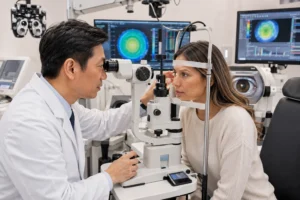
Choosing the best multifocal contacts involves much more than selecting a prescription.
A professional fitting typically includes:
- Comprehensive eye examination
- Updated vision prescription
- Corneal measurements
- Tear film evaluation
- Assessment of eye health
- Trial contact lenses
- Vision testing at different distances
- Follow-up visits for fine adjustments
Sometimes more than one lens design is tried before achieving the most comfortable and effective result.
Tips for Successful Adaptation
Adjusting to multifocal contact lenses takes patience. Most people adapt gradually over several days or a few weeks.
Helpful tips include:
- Wear the lenses consistently during the adaptation period.
- Blink regularly, especially when using digital screens.
- Follow the recommended replacement schedule.
- Use only approved lens care products.
- Avoid sleeping in lenses unless specifically approved.
- Attend follow-up appointments so your prescription can be fine-tuned.
When Should You See an Eye Doctor?
Schedule a comprehensive eye examination if you experience:
- Difficulty reading small print
- Frequent headaches during near work
- Blurred vision at multiple distances
- Contact lens discomfort
- Dry eye symptoms
- Changes in night vision
- Difficulty focusing between screens and printed material
Regular eye examinations are also important for detecting conditions such as glaucoma, cataracts, retinal disease, and other eye health concerns that may not cause early symptoms.
At LeeVision, Dr. David H. Lee, MD, a Board-Certified Ophthalmologist, provides evidence-based eye care using advanced diagnostic technology to help patients determine whether multifocal contact lenses are appropriate for their individual vision needs. The goal is not simply clearer vision but long-term eye health and personalized treatment planning.
Frequently Asked Questions
What are multifocal contact lenses?
What are multifocal contact lenses? They are contact lenses designed with multiple focusing zones that help you see clearly at near, intermediate, and far distances without changing glasses.
How do multifocal contact lenses work?
How do multifocal contact lenses work? They use different optical zones within the same lens. Your brain naturally selects the clearest image depending on whether you’re reading, using a computer, or looking into the distance.
Who should wear the best multifocal contacts?
Adults over 40 with presbyopia who want to reduce their dependence on reading glasses are often good candidates. A comprehensive eye examination determines whether they are the right choice.
Are multifocal contact lenses comfortable?
Yes, many modern multifocal contact lenses are comfortable when properly fitted. Comfort also depends on tear quality, eye health, and following the recommended replacement schedule.
Can multifocal contacts replace reading glasses?
For many daily activities they can, but some people may still prefer reading glasses for very small print or prolonged close work.
How long does it take to adjust to multifocal contacts?
Most patients adapt within a few days to several weeks, although the exact timeline varies from person to person.
Are daily disposable multifocal contact lenses better?
Daily disposable lenses are convenient and may reduce deposits on the lens, making them a good option for many patients. Your eye doctor can recommend the most suitable replacement schedule.
Can people with dry eyes wear multifocal contacts?
Many can, especially after appropriate dry eye treatment. Managing the underlying cause of dry eye often improves contact lens comfort.
Are multifocal contact lenses safe?
Yes. When prescribed and monitored by an eye care professional and worn according to instructions, multifocal contact lenses are considered safe for most healthy eyes.
How often should multifocal contact lenses be replaced?
Replacement depends on the specific lens type. Some are replaced daily, while others are replaced every two weeks or monthly. Always follow your eye doctor’s recommendations.
Do multifocal contacts help with computer vision?
Yes. Many multifocal lens designs include intermediate vision zones that are helpful for computer work and digital device use.
How can I choose the best multifocal contacts?
The best multifocal contacts depend on your prescription, eye health, tear film, daily activities, and visual goals. A professional contact lens fitting is the most reliable way to find the right option.