


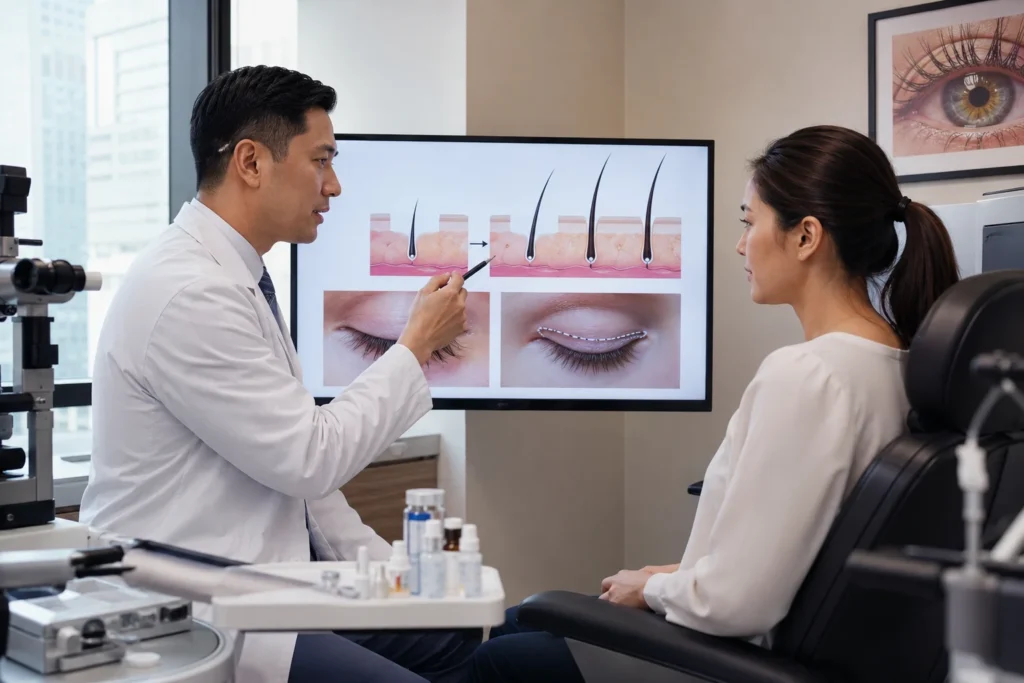
Eyelash Serum Growth: What Actually Works for Longer, Fuller Lashes?
Longer, thicker eyelashes are a common cosmetic goal, but choosing an eyelash serum is not as simple as picking the product with the most impressive before-and-after photos. Some lash products are cosmetics designed to condition the lashes, while others contain active medications that can influence the eyelash growth cycle.
For patients searching for eyelash serum growth, the most important question is not simply, “Which serum grows lashes fastest?” A better question is: What ingredient is in the product, how well has it been studied, and is it appropriate and safe for the delicate skin around my eyes?
This distinction matters because the eyelid margin is very different from ordinary facial skin. Products applied too close to the eye can cause irritation, allergic reactions, redness, or unwanted pigmentation. In some cases, a product marketed as an eyelash enhancer may not have the same level of clinical evidence as a prescription treatment.
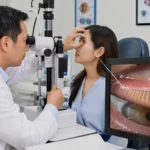
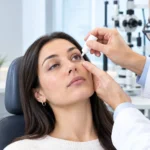
At LeeVision in Flushing, Queens, discussions about eyelash growth should begin with understanding the patient’s goals, existing eye health, medications, allergies, and the condition of the eyelids and eyelashes.
What Is Eyelash Serum Growth Treatment?
Eyelash growth treatments generally fall into two broad categories: cosmetic lash conditioners and prescription treatments.
Cosmetic products may contain ingredients intended to moisturize or condition the lashes. They can make eyelashes appear healthier or less prone to breakage, but that does not necessarily mean they increase the number of lashes growing from the follicle.
A prescription eyelash growth serum, on the other hand, may contain an active pharmaceutical ingredient with clinical evidence for increasing eyelash length, thickness, and darkness.
The best-known example is bimatoprost ophthalmic solution 0.03%, which is FDA-approved for treating eyelash hypotrichosis, a medical term for inadequate or insufficient eyelashes. FDA labeling describes its effect as increasing eyelash growth, including length, thickness, and darkness.
That does not mean every eyelash serum containing a similar-sounding ingredient is equivalent. Formulation, concentration, application method, regulatory status, and patient suitability all matter.
How Do Eyelash Growth Treatments Work?
Eyelashes naturally move through a growth cycle. Each lash grows for a period of time, eventually stops growing, and then sheds before a new lash develops.
A clinically proven medication such as bimatoprost works by influencing the eyelash growth cycle. With continued appropriate use, eyelashes may become longer, thicker, and darker.
The result is gradual rather than immediate. Patients should be cautious about products promising dramatically longer lashes within a few days because normal eyelash biology does not work that quickly.
Another important point is that treatment does not permanently change the eyelashes after the medication is stopped. The enhanced appearance generally diminishes over time as the lashes return toward their untreated growth cycle.
Best Product for Eyelash Growth: What Should You Look For?

When people search for the best product for eyelash growth, they often compare ingredients, prices, reviews, and social-media recommendations. From an eye-health perspective, the first comparison should be different: Is there reliable evidence that the product actually works, and is it safe for use around the eyes?
Consider these factors before choosing a lash product:
- Active ingredients: Know exactly what the serum contains.
- Clinical evidence: Look for evidence supporting eyelash growth rather than relying only on cosmetic claims.
- Application instructions: The eyelid margin requires careful application.
- Eye sensitivity: Patients with sensitive eyes, allergies, or chronic irritation may react differently.
- Existing medications: Some eye medications belong to the same general drug family as compounds associated with eyelash growth.
- Professional guidance: A physician can help determine whether thinning lashes are simply cosmetic or related to an underlying eyelid or eye condition.
It is also important to understand that “FDA regulated” and “FDA approved” are not interchangeable terms. FDA explains that cosmetics generally do not undergo premarket approval in the same way that drugs do.
Prescription Eyelash Growth Serum vs. Cosmetic Lash Serum
| Feature | Cosmetic Lash Serum | Prescription Treatment |
|---|---|---|
| Main purpose | Conditioning or improving lash appearance | Treating inadequate eyelash growth |
| Medical evidence | Varies considerably by product | Specific prescription medications have clinical evidence |
| FDA drug approval | Generally not applicable to cosmetics | Applies when the medication is FDA-approved for the indication |
| Medical evaluation | Usually not required | May be appropriate before treatment |
| Potential side effects | Irritation or allergy can occur | Eye and eyelid-related effects are possible |
| Best approach | Check ingredients and safety information | Discuss suitability with an eye-care professional |
This comparison is important because the phrase best product for eyelash growth can mean very different things to different patients. Someone looking for lash conditioning may not need a prescription medication, while someone with significant eyelash thinning may benefit from a medical evaluation.
Is a Prescription Eyelash Growth Serum Safe?
A prescription treatment can be appropriate for selected patients, but “prescription” does not mean “risk-free.”
Bimatoprost may cause side effects including eyelid skin darkening, eye irritation, redness, itching, and dry-eye symptoms. FDA labeling also warns about the possibility of increased brown pigmentation of the iris, which may be permanent.
There is another reason careful application matters. Repeated exposure of surrounding skin to prostaglandin-type medications can produce unwanted changes around the eyes. Ophthalmology references describe a condition known as prostaglandin-associated p eriorbitopathy, which can include changes in the eyelid contour and a deeper upper-eyelid appearance.
This is why a good eyelash-growth discussion should focus on more than achieving longer lashes. The goal is to balance cosmetic improvement with long-term eye and eyelid health.
When Should Eyelash Thinning Be Evaluated?
Not every change in eyelash density is simply a cosmetic issue.
If lashes suddenly become sparse, fall out in patches, or are accompanied by eyelid inflammation, itching, scaling, redness, or other eye symptoms, it is worth finding out why.
Eyelash loss can sometimes occur alongside eyelid inflammation, skin conditions, medication effects, or other medical problems. Treating the underlying issue may be more important than simply applying a growth serum.
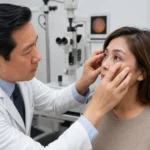
For patients in Flushing, Queens, NYC, an ophthalmic evaluation can help distinguish ordinary cosmetic concerns from eyelid or ocular-surface problems that deserve treatment.
At LeeVision, the emphasis should be on personalized evaluation and evidence-based eye care rather than choosing a lash product based solely on advertising claims.
Eyelash Serum Growth: What Patients Should Know Before Treatment
Choosing an eyelash growth treatment becomes easier once patients understand what can realistically change and what cannot. Eyelashes have a natural growth cycle, and even an effective treatment cannot produce overnight results.
For anyone researching eyelash serum growth, the most useful approach is to consider the cause of sparse lashes, the ingredients in the product, expected results, and possible effects on the eyes and eyelids.
How Long Does Eyelash Growth Treatment Take to Work?
One of the most common questions patients ask is how quickly they will notice a difference.
Prescription eyelash growth treatments generally require consistent use over time. Changes are gradual because the treatment works with the natural eyelash growth cycle rather than creating new lashes immediately.
Some patients may notice improvement after several weeks, while more noticeable changes can take longer. The final response varies from person to person.
This is also why before-and-after photographs found online should be interpreted carefully. Lighting, mascara, lash curling, camera angle, and the natural growth cycle can all change how eyelashes appear.
What Happens If You Stop Using It?
Stopping an eyelash growth treatment does not usually mean that the eyelashes suddenly disappear. Instead, the enhanced effect gradually fades as individual lashes complete their normal cycle.
Over time, eyelashes generally move back toward their previous appearance.
Patients should therefore think of effective lash-growth therapy as an ongoing treatment rather than a permanent cosmetic change.
Can Eyelash Serum Cause Eye Irritation?
Yes. Anything applied around the eyelids can potentially cause irritation, particularly in people with sensitive skin, allergies, dry eyes, or existing eyelid inflammation.
Possible symptoms can include:
- Redness around the eyelids
- Itching or irritation
- Dryness
- Eye redness
- Skin discoloration
- Burning or discomfort
The risk depends partly on the active ingredient and how the product is applied.
A common mistake is assuming that applying more serum will produce faster growth. It generally does not. Following the recommended application method is much more important than using a larger amount.
Eyelash Serum and Eye Health: Why Application Matters
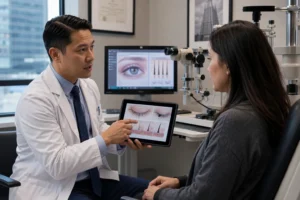
The eyelashes sit directly along the eyelid margin, close to the ocular surface. This makes application technique particularly important.
Patients should avoid deliberately getting lash-growth products into the eye unless the medication is specifically formulated and prescribed for ocular use.
With prescription bimatoprost, for example, the FDA-approved instructions specify application to the upper eyelid margin using the supplied applicator. The solution should not be applied to the lower eyelid.
Using an unapproved product near the eye can introduce additional uncertainty because cosmetic formulations may contain multiple ingredients that have not been studied to the same degree for long-term periocular use.
Can Eyelash Serum Change Eyelid or Skin Color?
Some lash-growth treatments can cause changes in pigmentation.
With bimatoprost, increased pigmentation of the eyelid skin may occur. More importantly, the FDA labeling warns that increased brown pigmentation of the iris can occur and may be permanent.
This is an important counseling point because a patient may initially focus only on longer eyelashes and overlook the possibility of pigmentation changes.
The decision to use a prescription eyelash growth serum should thberefore include a discussion of both the desired cosmetic benefit and the potential trade-offs.
What About Prostaglandin-Free Eyelash Serums?
Many cosmetic lash products are marketed as prostaglandin-free. These products may contain conditioning ingredients such as peptides, amino acids, vitamins, plant-derived ingredients, or other cosmetic compounds.
However, “prostaglandin-free” does not automatically mean that a product is guaranteed to grow eyelashes, nor does it mean that irritation is impossible.
The evidence behind cosmetic lash serums varies substantially from one formulation to another.
Patients searching for the best product for eyelash growth should therefore look beyond marketing language and ask:
- What is the active ingredient?
- Is there clinical evidence for actual eyelash growth?
- Is the product intended for use directly along the lash line?
- Has the manufacturer clearly identified possible adverse effects?
- Could the ingredients irritate my eyes or eyelids?
These questions are more useful than relying on online ratings alone.
Why Are My Eyelashes Thinning?
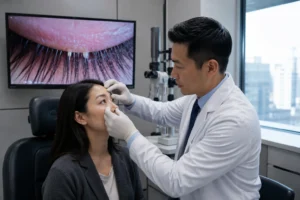
Before choosing an eyelash serum, it is worth asking whether there is a reason for the lash loss.
Eyelash thinning can occur for several reasons, including repeated rubbing, eyelid inflammation, cosmetic practices, trauma, and certain medical or dermatologic conditions.
For example, chronic blepharitis—an inflammation of the eyelid margins—can cause irritation and changes around the eyelashes. A patient who repeatedly rubs itchy eyes may also experience lash breakage or loss.
In these situations, simply applying a growth product may not address the underlying problem.
When Should You See an Eye Doctor?
An eye examination is especially reasonable when eyelash loss is:
- Sudden or unexplained
- Limited to one area or one eye
- Associated with persistent eyelid redness
- Accompanied by itching, scaling, or swelling
- Associated with eye pain or significant irritation
- Occurring together with other changes around the eyes
A physician can examine the eyelid margins, eyelashes, surrounding skin, and ocular surface to determine whether there is an underlying problem.
Common Eyelash Serum Mistakes Patients Should Avoid
Even a well-formulated product can cause problems when used incorrectly.
Applying Too Much Product
More is not necessarily better. Excess product can spread onto the surrounding skin and potentially increase irritation or unwanted exposure.
Applying Serum to the Lower Lash Line
Patients sometimes assume that applying treatment to both upper and lower lashes will produce better results. Prescription bimatoprost, however, has specific application instructions and should not be applied to the lower eyelid.
Sharing Applicators
Sharing cosmetic or prescription applicators can introduce contamination and is best avoided.
Continuing Despite Significant Irritation
Mild irritation should not simply be ignored. Persistent redness, swelling, pain, vision changes, or other concerning symptoms warrant medical attention.
Eyelash Growth Treatment: What Is a Realistic Expectation?
The most realistic expectation is gradual improvement rather than dramatic transformation.
A treatment may help suitable patients achieve lashes that appear longer, thicker, or darker. It cannot guarantee identical results for everyone, and it cannot necessarily restore lashes lost because of an untreated underlying condition.
Patients should also remember that eyelashes have an important protective function. They help reduce exposure of the ocular surface to dust and other particles, so maintaining healthy eyelids is more important than maximizing lash length.
For patients considering eyelash growth treatment in Flushing, Queens, NYC, an ophthalmologist can help determine whether the concern is primarily cosmetic or whether an eyelid or ocular-surface condition should be addressed first.
A Practical Way to Choose an Eyelash Growth Product
Rather than asking only, “What is the best product for eyelash growth?”, consider this sequence:
Identify the problem → review the ingredients → understand the evidence → assess eye and eyelid health → discuss risks and alternatives → choose an appropriate treatment.
That approach is more likely to produce a safe, informed decision than choosing a product solely because it has strong online reviews.
The goal should not simply be longer eyelashes. It should be healthy eyelashes without compromising the health of the eyes or eyelids.
Eyelash Serum Growth: FAQs Patients Commonly Ask
Patients often have very specific questions before starting an eyelash growth treatment. The most important thing is to separate evidence-based treatment from cosmetic marketing and to understand that a product that works for one person may not be appropriate for another.
Frequently Asked Questions About Eyelash Serum Growth
What is the best product for eyelash growth?
The best product for eyelash growth depends on what you mean by “growth.” Cosmetic lash conditioners may improve the appearance and condition of existing lashes, while an FDA-approved prescription treatment is intended to treat inadequate eyelash growth.
When comparing the best product for eyelash growth, look at the active ingredient, clinical evidence, application instructions, and potential side effects rather than relying only on online reviews.
Does eyelash serum actually grow eyelashes?
Some products can improve the appearance of eyelashes, but not every serum has evidence demonstrating true growth.
When researching eyelash serum growth, check whether the product has clinical evidence supporting increased lash length, thickness, or darkness. A conditioning serum and a prescription medication should not be considered interchangeable.
What is a prescription eyelash growth serum?
A prescription eyelash growth serum is a medication prescribed for inadequate or insufficient eyelashes. Bimatoprost ophthalmic solution 0.03% is FDA-approved to treat hypotrichosis of the eyelashes.
A prescription eyelash growth serum should be used according to the prescribing physician’s instructions because it can cause eye or eyelid-related side effects.
How long does eyelash serum take to work?
Eyelash growth is gradual because lashes follow a natural growth cycle. A person should not expect dramatic results within a few days.
With a clinically studied prescription eyelash growth serum, improvement develops with continued appropriate use, and individual responses vary.
Is eyelash serum safe for the eyes?
Safety depends on the specific product and its ingredients. Even cosmetic products can cause irritation when applied near the eye.
A medically appropriate eyelash serum growth treatment should be selected with attention to existing eye conditions, allergies, medications, and eyelid health.
Can eyelash serum cause redness?
Yes. Some eyelash products can cause redness, itching, irritation, or other reactions around the eyelids or eyes.
If redness continues after stopping a cosmetic product, or if there is pain, swelling, discharge, or vision changes, an eye examination is appropriate.
Can prescription eyelash serum change eye color?
This is an important consideration with bimatoprost. FDA labeling warns that increased brown pigmentation of the iris can occur and may be permanent.
For that reason, the decision to use a prescription eyelash growth serum should include a discussion of potential benefits and risks.
Can eyelash serum darken the skin around the eyes?
Yes. Bimatoprost may cause increased pigmentation of the eyelid skin. Patients considering eyelash serum growth should understand that cosmetic improvement is not the only possible effect.
What happens when I stop using eyelash serum?
The enhanced effect of an eyelash growth medication generally does not remain permanently after treatment stops. As lashes continue through their normal growth and shedding cycles, their appearance can gradually return toward the previous baseline.
This is an important expectation when considering the best product for eyelash growth.
Can I use eyelash serum if I have dry eyes?
Possibly, but it depends on the product and the individual’s eye health. Patients with dry eye symptoms or sensitive ocular surfaces should be particularly careful about products applied around the eyelids.
Before using a prescription eyelash growth serum, discuss existing eye symptoms with an ophthalmologist.
Can eyelash serum be used on the lower eyelashes?
Patients should not assume that a lash-growth product should be applied to both upper and lower lash lines.
For FDA-approved bimatoprost, the prescribing information directs application to the upper eyelid margin and specifically states that it should not be applied to the lower eyelid.
Is a prostaglandin-free eyelash serum better?
Not necessarily. “Prostaglandin-free” describes an ingredient profile; it does not automatically prove that a product is more effective or completely free from irritation.
When searching for eyelash serum growth, patients should evaluate the complete formulation and evidence rather than making the decision based on one marketing term.
What should I look for in the best product for eyelash growth?
Look for transparency about ingredients, appropriate directions for use, evidence supporting the product’s claims, and clear safety information.
The best product for eyelash growth is not necessarily the most expensive product or the one with the highest number of online reviews.
Can eyelash serum help eyelashes damaged by extensions?
It depends on why the lashes are sparse. Repeated extensions, adhesives, rubbing, or mechanical pulling can contribute to lash breakage or loss.
If the eyelashes remain unusually sparse after stopping damaging practices, an ophthalmologist can evaluate the eyelid and lash follicles before a patient starts eyelash serum growth treatment.
Why are my eyelashes suddenly falling out?
Sudden or patchy eyelash loss deserves more attention than ordinary cosmetic thinning. Eyelid inflammation, repeated rubbing, skin conditions, trauma, medications, and other factors can contribute to lash loss.
A prescription eyelash growth serum may not address the underlying cause if an eyelid disorder is responsible.
Should I see an ophthalmologist before using eyelash serum?
An examination can be particularly helpful when eyelash loss is sudden, one-sided, patchy, or associated with eyelid irritation.
For patients in Flushing, Queens, NYC, an ophthalmologist can assess the eyelids, eyelashes, ocular surface, and overall eye health before recommending an appropriate approach.
Can I use more serum to make my eyelashes grow faster?
No. Applying more product does not mean the eyelashes will grow faster. Excess exposure can increase the chance of unwanted skin or eye irritation.
Following the recommended instructions is more important than increasing the amount when using a prescription eyelash growth serum.
Is eyelash serum better than castor oil?
Castor oil is commonly promoted online for eyelashes, but it should not automatically be considered an evidence-based eyelash growth treatment.
Patients looking for eyelash serum growth should distinguish between products that condition lashes and treatments with clinical evidence for increasing eyelash growth.
What is the safest approach to eyelash growth?
The safest approach starts by identifying why the eyelashes are thin or sparse. If there is an underlying eyelid problem, that issue should be addressed rather than simply covering it with a cosmetic product.
For patients considering the best product for eyelash growth, professional guidance can help balance cosmetic goals with long-term eye and eyelid health.
Final Takeaway
Eyelash growth is a gradual biological process, not an overnight cosmetic transformation. Some cosmetic serums may condition lashes, while an evidence-based prescription eyelash growth serum can be appropriate for selected patients with inadequate eyelashes.
The right choice depends on the individual. Before starting treatment, patients should understand the active ingredients, realistic expectations, application method, potential side effects, and available alternatives.
For patients in Flushing, Queens, New York City, an ophthalmologist can also determine whether thinning eyelashes are simply a cosmetic concern or a sign of an underlying eyelid or ocular-surface problem.
About LeeVision
LeeVision provides ophthalmic care in Flushing, Queens, with an emphasis on evidence-based evaluation and personalized treatment planning. Dr. David H. Lee, MD, is a board-certified ophthalmologist who can evaluate eye and eyelid concerns and help patients make informed decisions about their eye health.