


Under Eye Bags Laser Treatment: What Patients Should Know Before Choosing a Treatment
Under-eye bags are one of those cosmetic concerns that can make a person look tired even after a full night’s sleep. For some people, the problem is mainly puffiness or inherited fat pockets beneath the eyes. For others, loose skin, fine wrinkles, pigmentation, allergies, or age-related changes make the area appear heavier.
That is why under eye bags laser treatment is not a one-size-fits-all procedure. The most appropriate treatment depends on what is actually creating the appearance of bags.
For patients searching for laser treatment for under eye bags, the first question should not be, “Which laser is best?” It should be, “What is causing my under-eye bags?”
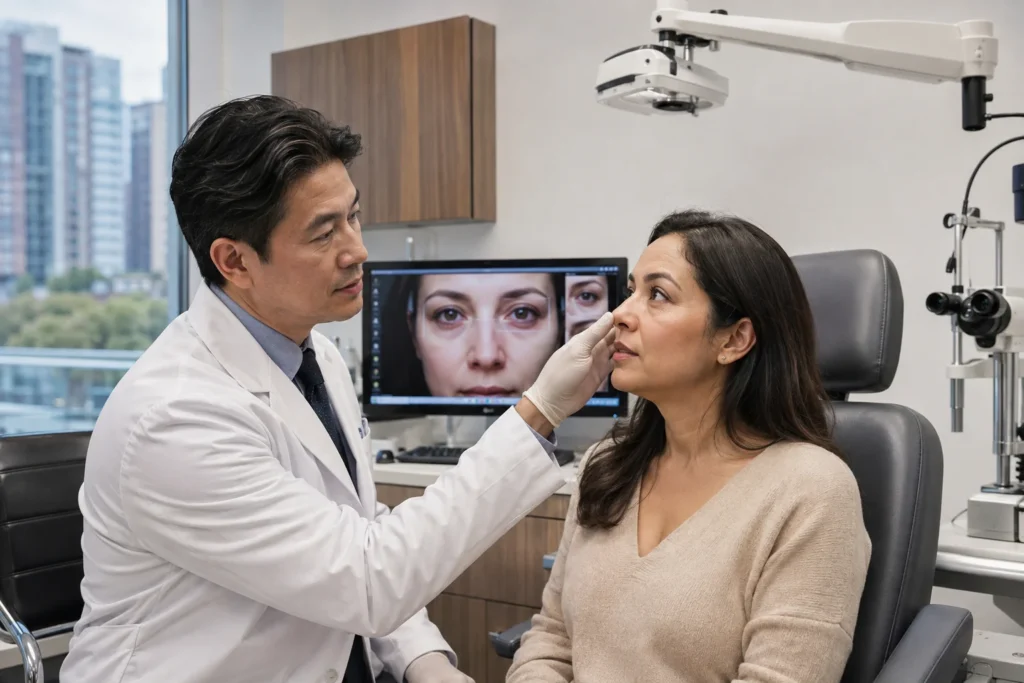
At LeeVision in Flushing, Queens, NYC, a careful evaluation can help distinguish between skin laxity, wrinkles, swelling, hollowness, and structural changes around the lower eyelid. This distinction matters because a laser may be useful for one concern while another treatment may be more appropriate for a different cause.
What Causes Under-Eye Bags?
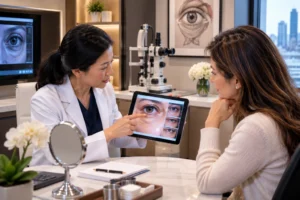
The term “under-eye bags” describes an appearance rather than a single medical condition. Several changes can contribute to it.
Age-Related Changes Around the Lower Eyelid
As we age, the tissues supporting the lower eyelid gradually change. Skin can become thinner and less elastic, while the structures that normally hold orbital fat in place may weaken. Fat can then become more noticeable beneath the lower eyelid, creating a persistent bulge.
Genetics also play an important role. Some people develop prominent under-eye bags relatively early in life even when they sleep well and maintain healthy habits.
Fine Lines and Loose Skin
Sometimes the main concern is not a prominent fat pocket but thin, crepey skin and wrinkles underneath the eyes.
This is where laser resurfacing may have a role. Depending on the technology used, laser resurfacing can target damaged surface skin and stimulate changes in collagen, potentially improving fine lines, texture, and skin firmness.
However, improving the skin surface is different from removing an underlying fat pocket.
Temporary Puffiness
Not every swollen-looking lower eyelid is a permanent “bag.”
Allergies, sinus congestion, fluid retention, lack of sleep, and irritation can temporarily make the lower eyelids look puffy. In these situations, treating the underlying cause may be more useful than immediately considering a cosmetic laser procedure.
This is particularly relevant for people living busy, screen-heavy lifestyles in New York City, where long workdays, environmental allergies, and irregular sleep schedules can all contribute to an older or more tired-looking appearance.
Does Laser Treatment Actually Remove Under-Eye Bags?
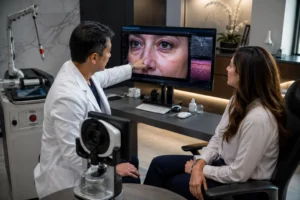
This is one of the most important questions patients ask.
Sometimes laser treatment can improve the appearance of the lower eyelid, but it does not automatically remove every type of under-eye bag.
Laser resurfacing is primarily useful when fine wrinkles, sun-damaged skin, uneven texture, or some degree of skin laxity contributes to the appearance. It can make the skin look smoother and may improve the overall transition between the lower eyelid and cheek.
A true bulging fat pocket is different. When excess or displaced orbital fat is the dominant problem, a lower eyelid procedure such as blepharoplasty may be considered. Lower blepharoplasty can involve removing or repositioning fat and, when necessary, addressing excess skin.
Why the Difference Matters
Imagine two patients with almost identical-looking under-eye bags.
One may have mostly fine wrinkles and loose skin. Another may have a pronounced fat pocket with relatively good skin quality.
Calling both problems “under-eye bags” does not mean they should receive the same treatment.
This is why an experienced evaluation is more useful than choosing a treatment based only on photographs or online advertisements.
What Can Laser Treatment for Under Eye Bags Improve?
Depending on the laser technology and the patient’s anatomy, treatment may be considered for:
- Fine lines beneath the eyes
- Crepey or sun-damaged skin
- Uneven skin texture
- Certain forms of mild skin laxity
- Some pigmentation concerns
- Overall skin rejuvenation around the lower eyelid
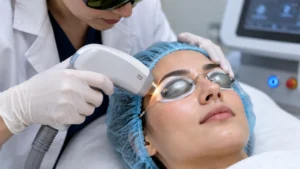
Laser resurfacing works by delivering controlled energy to the skin. Some approaches remove portions of the outer skin while heating deeper tissue, encouraging the formation of new collagen as the area heals.
The exact approach matters because the skin around the eyes is extremely delicate.
Laser Treatment vs. Lower Blepharoplasty
| Concern | Laser Treatment | Lower Blepharoplasty |
|---|---|---|
| Fine wrinkles | May help | May help |
| Skin texture | Often a target | Can improve when excess skin is addressed |
| Mild skin laxity | May improve | Can address more significant laxity |
| Prominent fat pockets | Limited effect | Directly addresses fat |
| Excess lower-eyelid skin | Limited | Can remove or reposition tissue |
| Recovery | Depends on laser type | Surgical recovery required |
The important point is that these treatments are not necessarily competitors. In carefully selected patients, different techniques may address different components of the same cosmetic concern.
Is There a Natural Treatment for Under Eye Wrinkles?
Patients frequently search for an under eye wrinkle natural treatment because they want to avoid procedures.
Healthy sleep, sun protection, avoiding smoking, managing allergies, and using appropriately formulated skincare can support the appearance and health of the delicate skin around the eyes. However, natural measures cannot reliably reposition protruding orbital fat or reverse significant structural changes caused by aging.
A realistic goal is important: skincare may support healthier-looking skin, while procedures are considered when structural or more pronounced cosmetic changes are present.
What Should You Ask Before Choosing Under Eye Bags Laser Treatment?
Before undergoing treatment, patients should understand exactly what is being treated.
Ask:
- Are my under-eye bags caused by fat, loose skin, wrinkles, pigmentation, or swelling?
- Would laser treatment address the actual cause?
- Which type of laser is being recommended and why?
- Is the treatment ablative or nonablative?
- What level of downtime should I expect?
- Could another treatment provide a better result?
- What are the possible risks for my particular skin and eyelid anatomy?
Lasers are medical devices and, like other procedures, can have risks including pain, infection, scarring, and changes in skin pigmentation.
A consultation should therefore focus on appropriate treatment selection rather than simply choosing the newest technology.
At LeeVision, patients can explore their concerns with a board-certified ophthalmologist and receive an individualized assessment based on their eye health, eyelid anatomy, skin condition, and treatment goals. The goal is not to promise a particular cosmetic result, but to determine which approach is medically and aesthetically appropriate.
Choosing the Right Treatment for Under-Eye Bags
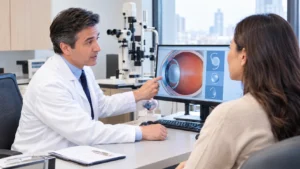
A consultation for under eye bags laser treatment should begin with an examination, not with a decision about which laser to use. The lower eyelid is a small but anatomically complex area, and the appearance of bags can come from several different factors.
A good evaluation looks at the eyelid skin, fat distribution, muscle, tear-trough area, facial structure, skin quality, and the relationship between the lower eyelid and cheek. Previous eye procedures, dry-eye symptoms, allergies, medications, and healing history can also be relevant when considering treatment.
Who May Be a Candidate for Laser Treatment for Under Eye Bags?
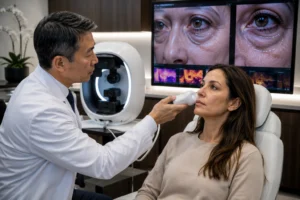
Laser resurfacing may be considered when the primary concern involves fine lines, sun-damaged skin, uneven texture, or mild-to-moderate skin laxity. Ophthalmology references describe laser resurfacing as a way to improve skin tone, texture, pigmentation, and wrinkles, but emphasize that it is not a substitute for blepharoplasty when structural eyelid changes require surgery.
A person with significant bulging fat beneath the lower eyelids may need a different approach. In such cases, lower eyelid blepharoplasty may be considered because it can directly address excess or displaced tissue.
When Laser May Not Be the Best Choice
Laser treatment may not be the ideal answer when the dominant issue is:
- Prominent lower-eyelid fat
- Significant excess skin
- Marked eyelid laxity
- Deep hollowness beneath the eyes
- Temporary swelling from allergies or fluid retention
- A combination of several structural concerns
This does not mean laser treatment has no role. In some patients, different treatments may be used to address different aspects of the lower-eyelid appearance.
What Happens During an Under-Eye Evaluation?
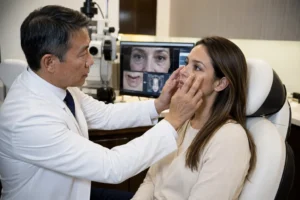
The consultation should establish what patients sometimes describe simply as “bags.”
An ophthalmologist may examine eyelid position, skin quality, fat prominence, tear-film function, and the surrounding tissues. If a patient has dry-eye symptoms, that should also be considered because procedures involving the eyelids can affect the ocular surface and eyelid function.
This is particularly important around the eyes. The goal is not simply to make the skin tighter; the eyelids also have an important protective role for the eye.
Why Your Eye Health Matters
Patients often think of under-eye treatment as purely cosmetic. From an ophthalmology perspective, the eyes themselves still matter.
A complete assessment can help identify conditions such as ocular surface irritation, eyelid abnormalities, or other eye-health concerns that may influence treatment planning. Personalized decision-making is especially important when a cosmetic procedure is being considered close to the eye.
What Types of Laser Treatment Are Used?
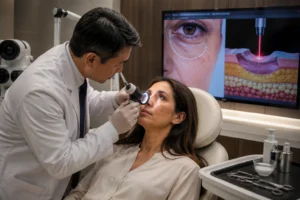
Laser resurfacing generally falls into two broad categories: ablative and non-ablative treatments.
Ablative lasers remove controlled portions of the outer skin and can produce more substantial resurfacing, while non-ablative approaches heat targeted deeper tissue while leaving the surface more intact. The appropriate choice depends on the patient’s skin, degree of wrinkles, pigmentation, recovery expectations, and treatment goals.
There is no single laser that is automatically “best” for every patient.
The treatment should be selected according to the problem being treated rather than according to the popularity of a particular device.
What Is Recovery Like After Laser Resurfacing?
Recovery varies considerably depending on the laser type and treatment intensity.
After resurfacing, patients may experience redness, swelling, sensitivity, dryness, peeling, or temporary changes in skin appearance. More aggressive resurfacing generally requires more healing time than lighter treatments.
Patients should follow their physician’s aftercare instructions carefully, including recommendations regarding sun protection and skin care.
When Should You Expect Results?
Laser resurfacing does not usually create an instant final result.
The skin needs time to heal and remodel. Improvements in texture and fine lines may become more noticeable as recovery progresses and collagen remodeling occurs.
The realistic goal is improvement, not completely eliminating every wrinkle or creating permanently smooth skin.
What Are the Risks of Under Eye Bags Laser Treatment?
Because the skin around the eyes is delicate, laser treatment should be performed with appropriate expertise and safety precautions.
Potential complications can include prolonged redness, pigmentation changes, infection, scarring, burns, and other unwanted skin changes. The specific risk depends on the patient’s skin characteristics, the laser technology, treatment settings, and aftercare.
FDA guidance recognizes that medical lasers require appropriate safety controls and that laser procedures can carry risks when used improperly.
This is one reason patients should be cautious about choosing treatment solely because an advertisement promises dramatic results.
Laser Treatment or Surgery: Which Is Better?
There is no universal answer.
| Patient Concern | Treatment That May Be Considered |
|---|---|
| Fine lines and skin texture | Laser resurfacing |
| Mild skin laxity | Laser may be considered |
| Prominent fat pockets | Lower blepharoplasty may be more appropriate |
| Excess lower-eyelid skin | Surgical evaluation may be appropriate |
| Temporary puffiness | Treat the underlying cause |
| Combination of wrinkles and bags | Combination treatment may be considered |
The important distinction is that laser resurfacing primarily treats the skin, while lower eyelid surgery can address deeper structural changes.
Can an Under Eye Wrinkle Natural Treatment Replace Laser?
Patients who prefer an under eye wrinkle natural treatment can start with measures that support healthy skin.
Daily sun protection, adequate sleep, avoiding smoking, gentle skin care, and appropriate moisturization can help maintain the appearance of the delicate skin around the eyes. Managing allergies may also help when puffiness is related to irritation or congestion.
However, these measures cannot reliably remove a structural fat pocket or reverse substantial age-related tissue changes.
That does not make natural care useless. It simply means that expectations should match what each treatment can realistically accomplish.
Questions Patients Should Ask Before Treatment
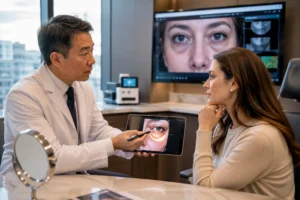
Before choosing laser treatment for under eye bags, consider asking:
- What is actually causing my under-eye bags?
- Is my main problem skin, fat, hollowness, or swelling?
- Would laser treatment address the underlying problem?
- Which laser technology is being recommended?
- How much downtime should I expect?
- What are the risks for my skin type?
- Would blepharoplasty or another option be more appropriate?
- Could my dry-eye symptoms affect treatment planning?
- What result is realistically achievable?
These questions help turn a cosmetic procedure into an informed medical decision.
For patients in Flushing, Queens, NYC, an individualized evaluation with a board-certified ophthalmologist can be particularly valuable when treatment involves the delicate tissues surrounding the eyes. At LeeVision, the focus should remain on understanding the patient’s anatomy, eye health, concerns, and realistic treatment options rather than assuming that one procedure is appropriate for everyone.
Realistic Results From Under Eye Bags Laser Treatment
The goal of under eye bags laser treatment should be improvement, not perfection. Laser resurfacing can improve the appearance of fine wrinkles, uneven texture, pigmentation, and certain degrees of skin laxity, but it is not a replacement for surgery when prominent lower-eyelid fat or significant excess tissue is the main concern. The American Academy of Ophthalmology’s EyeWiki guidance updated in 2026 specifically notes that laser resurfacing is not a substitute for blepharoplasty.
Results also develop gradually. Skin needs time to heal and remodel after treatment, and the final appearance can vary according to the laser used, treatment intensity, skin type, age, and individual healing response.
Can Under-Eye Bags Come Back?
Laser treatment does not stop the natural aging process.
If the treatment improves fine lines or skin texture, those improvements may be noticeable for some time, but future sun exposure, aging, changes in skin elasticity, and other factors can gradually affect the appearance again.
Similarly, if a patient has structural fat protrusion beneath the eyes, laser resurfacing does not permanently eliminate that underlying anatomy.
When Should You Consider an Eye Specialist?
A consultation is especially worthwhile when under-eye swelling is persistent, asymmetric, suddenly appears, or is accompanied by other eye symptoms.
Patients should not automatically assume that every change beneath the eyes is an age-related cosmetic problem. Allergies, irritation, fluid retention, eyelid conditions, and other issues can sometimes contribute to puffiness.
For patients in Flushing, Queens, NYC, an ophthalmologist can evaluate the eyelids while also considering the health and function of the eyes themselves.
Common Misconceptions About Laser Treatment for Under Eye Bags
“Laser Removes Every Under-Eye Bag”
Not necessarily. Laser resurfacing primarily addresses the skin. Prominent orbital fat or significant excess tissue may require a different treatment approach.
“Natural Treatments Can Permanently Remove Bags”
Healthy habits and skincare can support healthier-looking skin, but they cannot reliably reposition structural fat or reverse substantial tissue laxity.
“More Powerful Laser Means Better Results”
More aggressive treatment is not automatically better. Laser selection and treatment intensity should be based on the patient’s skin, anatomy, goals, and ability to tolerate recovery.
“There Is No Risk Because It Is Cosmetic”
Laser procedures still have potential complications. Depending on the treatment, patients may experience redness, swelling, pigmentation changes, infection, burns, scarring, or delayed healing.
Frequently Asked Questions About Under Eye Bags Laser Treatment
Is laser treatment good for under-eye bags?
Under eye bags laser treatment can be useful when wrinkles, uneven texture, sun damage, or mild skin laxity contribute to the problem. It may be less effective when prominent fat pockets are the primary cause.
Does laser treatment for under eye bags remove fat?
Usually, laser skin resurfacing is designed to improve the skin rather than directly remove or reposition orbital fat. If prominent fat is responsible for the bags, an ophthalmologist may discuss other options, including lower blepharoplasty.
What is the best laser treatment for under-eye bags?
There is no single best laser for everyone. The appropriate technology depends on whether the main concern is fine lines, pigmentation, texture, or skin laxity, as well as the patient’s skin characteristics and treatment goals.
How long does under eye bags laser treatment take?
Treatment time varies according to the area being treated, laser technology, preparation, and treatment intensity. A consultation is needed to determine the expected treatment time for an individual patient.
Is laser treatment for under eye bags painful?
Patients can experience heat, stinging, or discomfort during laser treatment. The amount of discomfort depends on the technology and treatment intensity, and appropriate anesthesia or numbing measures may be used when indicated.
How long does recovery take after laser treatment for under-eye bags?
There is no single recovery period for every patient. Lighter treatments generally involve less downtime, while more aggressive resurfacing can require a longer healing period. Redness, swelling, peeling, and sensitivity can occur during recovery.
Does laser treatment for under-eye bags tighten loose skin?
It can improve certain degrees of skin laxity, particularly when collagen remodeling is part of the treatment response. However, significant excess skin may require surgical evaluation rather than relying on laser resurfacing alone.
Can laser treatment remove under-eye wrinkles?
Laser resurfacing can improve fine wrinkles and skin texture. The extent of improvement depends on the depth of the wrinkles, skin quality, laser type, and individual healing response.
What is an under eye wrinkle natural treatment?
An under eye wrinkle natural treatment may include consistent sun protection, avoiding smoking, adequate sleep, gentle skincare, and maintaining healthy skin habits. These measures can support skin health but cannot reliably reverse structural aging or remove prominent fat pockets.
Can an under eye wrinkle natural treatment replace laser resurfacing?
For mild cosmetic concerns, some patients may prefer skincare and lifestyle measures. However, an under eye wrinkle natural treatment generally cannot produce the same degree of resurfacing that a medical laser can provide for certain wrinkles or texture concerns.
Are under-eye bags caused by lack of sleep?
Poor sleep can make the area around the eyes look more tired or puffy, but persistent under-eye bags can also result from genetics, aging, skin laxity, and protruding orbital fat. Therefore, sleep alone is not always the explanation.
Can allergies cause under-eye bags?
Yes. Allergies and associated rubbing or congestion can contribute to swelling around the eyes. When puffiness fluctuates with allergy symptoms, treating the underlying irritation may be more appropriate than immediately pursuing cosmetic treatment.
Is laser treatment safe around the eyes?
Laser treatment around the eyes requires careful patient selection, appropriate protective measures, and experienced medical oversight. The risks depend on the device, settings, treatment area, and patient factors.
Is laser treatment better than lower blepharoplasty?
Neither is universally better. Laser resurfacing is primarily a skin treatment, while lower blepharoplasty can address excess or displaced lower-eyelid tissue. The correct choice depends on the underlying anatomy.
Can laser treatment for under eye bags improve dark circles?
Sometimes, depending on why the circles are present. Pigmentation may respond differently from shadows caused by hollowness or prominent fat. A proper evaluation is important because dark circles have several possible causes.
How many laser treatments will I need?
The number of treatments depends on the laser technology, treatment goal, skin condition, and desired degree of improvement. Some patients may be considered for one treatment, while others may require a series.
Does laser treatment permanently remove under-eye wrinkles?
No cosmetic procedure can guarantee permanent wrinkle removal. Laser resurfacing can improve wrinkles and skin quality, but aging and environmental exposure continue over time.
Should I choose laser treatment for under eye bags in Flushing Queens?
Patients in Flushing, Queens, NYC can benefit from having the underlying cause of their under-eye concern evaluated locally rather than selecting a procedure solely from an online search. A board-certified ophthalmologist can determine whether the concern is primarily related to skin, fat, swelling, or another eyelid issue.
Can men have laser treatment for under-eye bags?
Yes. The principles of evaluation are similar, although facial anatomy, skin characteristics, and individual treatment goals differ from person to person.
What should I do before choosing laser treatment for under-eye bags?
Start with a professional evaluation. Ask what is causing the bags, what the recommended laser is expected to improve, what alternatives exist, how much downtime is expected, and what risks apply specifically to you.